
How to Choose a Dog Bed: Shape, Material, Size, and What to Look For
Most people spend more time choosing a dog bed than they expect to. The shape that suits one dog is wrong for another. The material perfect for winter is the last thing you want in July. Size looks obvious until you measure, and then it isn't. This guide exists to make that process straightforward — covering what actually matters, in the order it matters.
Start with how your dog actually sleeps
The single most useful starting point is observation — not measurement, not aesthetics, but simply watching how the dog naturally rests when undisturbed.
Dogs have distinct and consistent sleeping habits, and a bed designed against them will be ignored regardless of its quality. There are broadly three patterns worth recognising.
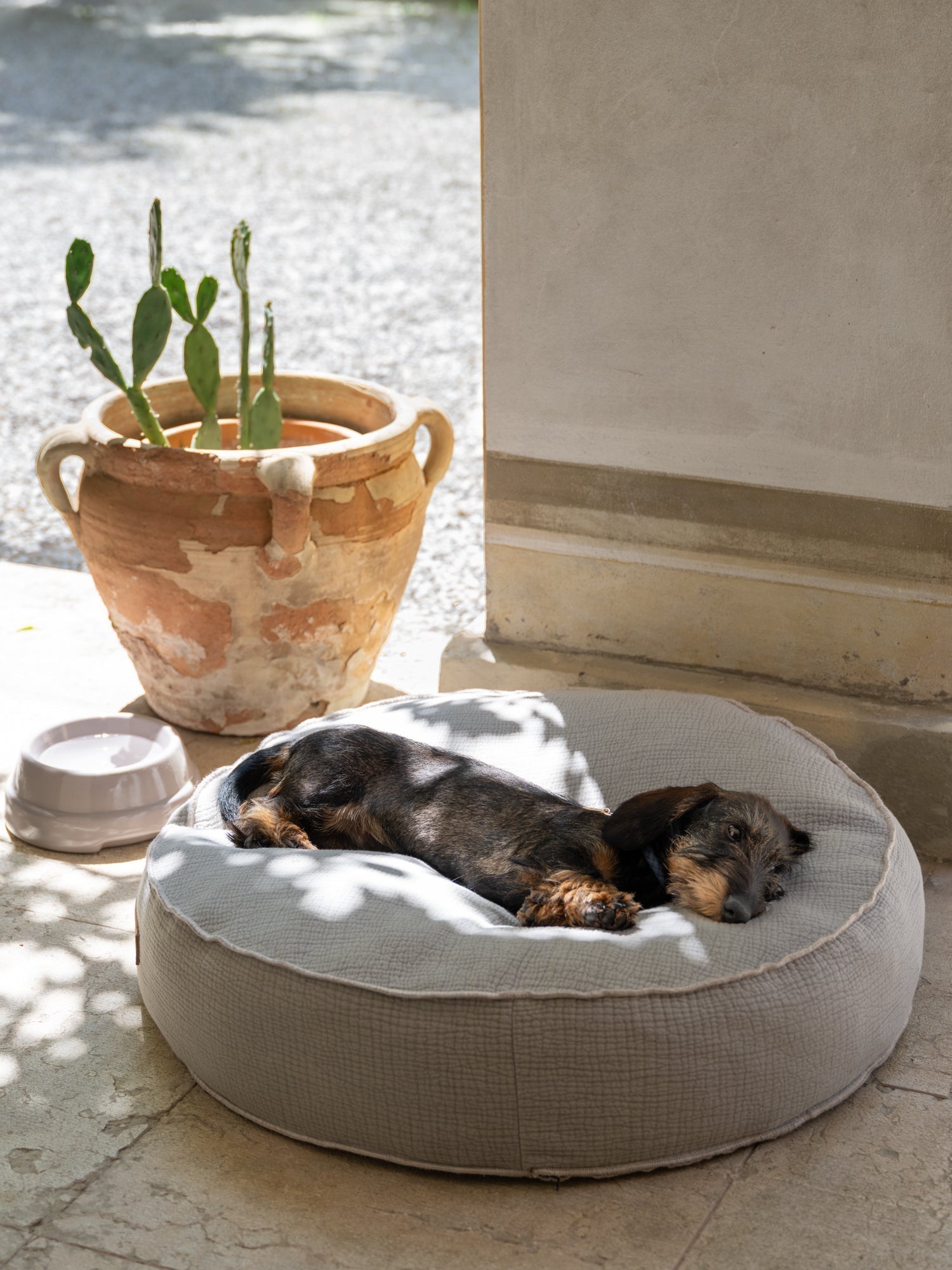
Some dogs curl tightly to sleep, nose toward tail, body compact and contained. This is a thermoregulatory behaviour — curling conserves body heat and protects the more vulnerable parts of the abdomen. Dogs that sleep this way tend to seek out enclosed spaces and feel most secure in a round or bolstered bed that supports the curl and creates a defined edge around them. A flat rectangular mat gives them nowhere to anchor.
Others sleep fully stretched — on their side, limbs extended, occupying considerably more space than their standing dimensions would suggest. These dogs need a surface long enough to accommodate their full length without hanging off the edge, and they generally don't benefit from raised sides since they don't use them. A rectangular bed at the appropriate size is the right format here.
A third pattern is common in larger breeds and older dogs: lounging rather than sleeping, shifting position frequently across the day, sometimes resting the head on a raised surface, sometimes spreading flat. These dogs benefit less from a conventional bed and more from something closer to a structured support surface — a day bed format that accommodates movement and provides consistent pressure relief across different positions.
Understanding which of these describes your dog is the first decision, because it will determine the shape of what you're looking for before material, size, or colour enters the picture at all.
Shape: what the differences actually mean
Round beds exist to support the curling posture. The raised edge that characterises most round cushions serves a function — it gives the dog something to rest against, which mimics the enclosed feeling of a burrow and is instinctively calming for dogs that curl. The size matters: the bed should be large enough that the dog can curl fully without touching both sides simultaneously, but not so large that the raised edge loses its containment effect. As a general principle, the dog's curled diameter — the space occupied when fully curled in sleep — plus a margin of around 10 to 15 cm is a reasonable guide.
Rectangular beds are more versatile and suit a wider range of body types and sleeping styles. The key sizing principle is that the dog should be able to stretch fully on the surface without any part of them hanging off the edge — and since most dogs sleep larger than they stand, measuring length from nose to base of tail in a relaxed lying position is the more accurate approach. A bed that is slightly too large is far preferable to one that is slightly too small.
Day beds are a different category of object. Rather than a bed in the conventional sense, they function more as resting furniture — structured enough to maintain their form under sustained use, supportive enough to accommodate a dog that shifts position frequently, and proportioned to sit naturally within a living space rather than beside it. For larger breeds especially, a well-made day bed with quality support underneath — memory foam, rather than loose polyester — makes a meaningful difference to how the dog rests, particularly as they age.
Material: the decision that matters most
Material is where the most consequential choices are made, and where the most misleading advice circulates. The question is not simply which material feels nicest but what properties it has, how it behaves across different seasons, and how it performs under the specific conditions of the dog that will be using it.
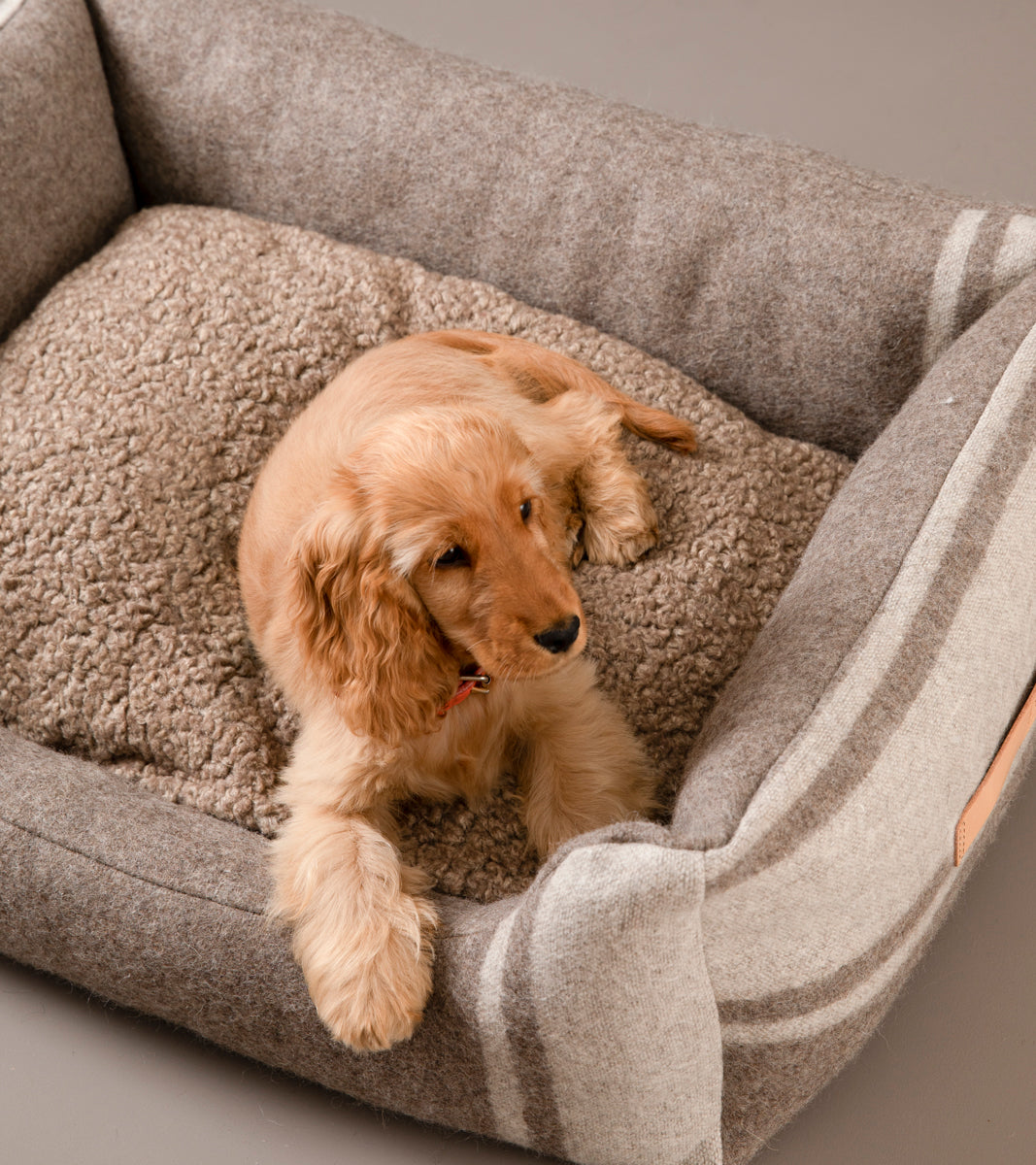
Wool is among the most intelligent choices for a dog bed, for reasons that go beyond warmth. Wool is a natural thermoregulator — it insulates in cold conditions and breathes in warm ones, which means a wool bed is genuinely appropriate across a wider range of temperatures than synthetic fabrics. More practically, wool naturally resists odour absorption, which is not a minor consideration in a piece of furniture used daily by an animal. It does not trap smells in the way that polyester fleece or foam does, which makes it better suited to shared living spaces — sitting rooms, bedrooms — where the bed needs to coexist comfortably with the rest of the interior. Recycled wool in particular, like that used in the Henri bed, offers these same properties while using reclaimed fibre rather than virgin material.
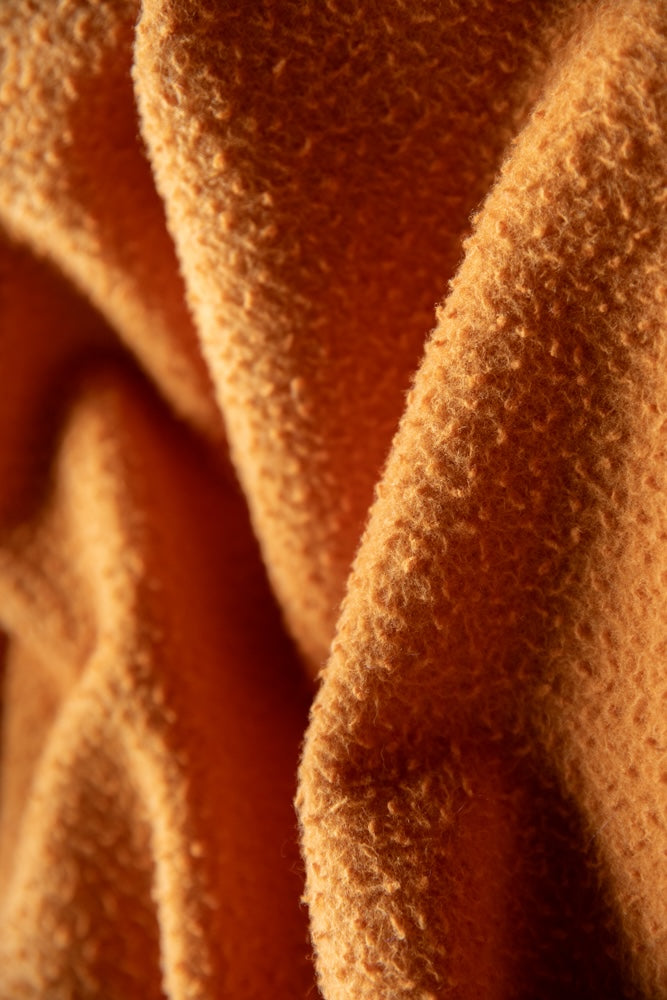
Bouclé wool is a specific construction of wool — the looped, textured surface that gives it its characteristic feel — rather than a different material. It is warmer and more insulating than flat wool and performs at its best in cooler conditions or climates. The texture also means it holds its visual character over time rather than pilling or flattening as cheaper synthetic fabrics do. It is not the right choice for dogs that run very warm or for households in consistently hot climates.
Linen is the material that manages summer. Pure linen is naturally breathable, hypoallergenic, and has a cooling effect against the skin — it draws heat away from the body rather than retaining it, which is the opposite of what wool does. For dogs that overheat, for breeds with dense coats, or for households in warmer climates, linen is the more honest choice than a wool bed that the dog will avoid in July. The Edward linen bed is worth understanding in this context — linen also gets softer and more refined with every wash, which means it improves with use rather than degrading.
Elephant cotton is a densely woven cotton known for its durability and softness. It is cooler than wool, more substantial than standard cotton, and holds its form well under daily use. When combined with a proper memory foam fill — as in the Giampaolo day bed — the surface material becomes secondary to the structural support underneath, which is where the real work is happening for larger or older dogs.
Waxed cellulose paper, used as an outer shell rather than a sleeping surface, brings a practical intelligence to the beds that incorporate it. It wipes clean rather than absorbing surface dirt, providing a protective layer between the cushion and the floor. The Irving round cushion uses this construction with a reversible cover — bouclé wool on one side and stain-resistant cotton canvas on the other — which gives it genuine seasonal flexibility within a single product.
What's inside matters as much as what's outside
The filling of a dog bed determines whether it maintains its support over months and years, or collapses into a thin layer of displaced padding within weeks.
Loose polyester fill is the most common and least durable option. It migrates, compresses, and flattens under sustained weight, which is why many inexpensive beds lose their shape quickly. A better approach is chamber-divided filling, which compartmentalises the padding so it cannot all shift to one side — the Fulvio cushion uses this construction specifically to distribute weight evenly and preserve the raised edge that gives the round cushion its function.
Memory foam is the most supportive option for dogs that spend significant time resting, particularly larger breeds or older dogs whose joints benefit from consistent pressure distribution. The key certification to look for is CertiPUR-US, which indicates the foam has been tested for harmful chemicals — relevant because dogs spend extended periods in direct contact with the surface.
Anti-parasitic filling — used throughout the 2.8 sleeping collection — is worth noting separately. The polyester filling is treated to be resistant to dust mites and parasites, which is a practical hygiene advantage in a product that cannot be fully machine-washed as a unit. The cover washes; the filling is protected.
A removable, machine-washable cover is non-negotiable in a quality dog bed. A bed that cannot be properly cleaned will accumulate allergens, dander, and odour regardless of how good its materials are. All beds in the 2.8 collection are finished with performance zippers that allow the cover to be removed cleanly and washed without dismantling the entire bed.
Seasonality and interchangeable covers
One of the less obvious aspects of choosing a well-made dog bed is that the right material varies across the year — and the most practical solution to this is not buying a different bed for each season, but choosing a bed model that supports interchangeable covers.
Several beds in the 2.8 collection — including Henri, Fulvio, and Edward — offer replacement textiles in different materials within the same model. This means the structure, the filling, and the frame of the bed remain constant, while the surface material shifts with the season. A wool cover in winter; a cotton or linen cover in summer. It is a more considered approach than the alternative, and it means the investment in the bed extends rather than being renegotiated every few months.
Sizing: the practical guide
Size is where many people default to instinct rather than measurement, and get it wrong as a result. Dogs sleep considerably larger than they stand, and a bed sized to a dog's standing footprint will almost always be too small in use.
For rectangular beds, measure the dog's length from nose to base of tail when lying fully stretched on one side — this is the governing dimension. Add a margin of at least 10 cm to that figure. Then check the width against how the dog tends to lie: a dog that sleeps with legs extended to the side needs more width than one that lies with legs tucked forward.
For round beds, measure the dog's curled diameter — the circle occupied when sleeping in a natural position. Add a margin of 10 to 15 cm for comfort.
The 2.8 size guide provides a useful reference by breed: smaller breeds including miniature dachshunds, Maltese, miniature poodles, and Chihuahuas suit the smaller sizes across the range; medium breeds including French Bulldogs, Whippets, Cavalier King Charles Spaniels, and Jack Russells fall in the medium sizes; larger breeds including Border Collies, Vizslas, Dobermans, and Weimaraners suit the large to extra-large options. For very large breeds, the Giampaolo day bed in XL accommodates dogs up to the scale of German Shepherds, Bernese Mountain Dogs, and similar.
When in doubt between two sizes, go larger. A dog will settle comfortably into a bed that is somewhat too generous; they will not thank you for one that is too small.
Secondary cushions: the case for a second resting spot
Something that often goes unconsidered in the initial bed purchase is the question of where else in the home the dog actually rests — because it is rarely only in one place.
Most dogs follow their people through the house across the day, settling temporarily wherever the household activity is: beside the desk, at the edge of the kitchen, on the landing. A primary bed addresses the main sleeping space; it does not address the dog that has parked on the bathroom tiles because you are working nearby.
The Richard cushion came out of exactly this observation. Anna, 2.8's co-founder, began bringing Quintale — her dachshund, and one of the two dogs at the heart of the brand — to the studio each day. She needed something for him: a proper resting surface that didn't dominate a room, that could move easily between spaces throughout the day, and fold flat when not in use. The result is a thin, foldable mat in bouclé wool with a paper base and a leather corner handle — slim enough to slide under a desk, fold against a wall, or tuck away when the day is done. It is not a replacement for a primary bed; it is a complement to one, designed to follow the dog through the rooms of a home rather than anchor them to a single spot.
Personalisation
Many of the beds in the 2.8 sleeping collection can be personalised with an embroidered name — a finishing touch that makes a considered piece feel genuinely one of a kind. Details on which products offer personalisation can be found on the individual product pages.
Browse the full sleeping collection — beds, cushions, day beds, blankets, and interchangeable covers — at duepuntootto.com.