
Article: Flying with a Dog in the Cabin: How to Choose a Carrier and Prepare
Flying with a Dog in the Cabin: How to Choose a Carrier and Prepare
Most small dogs can fly in the cabin, at your feet, for the whole journey. Whether yours can depends on rules each airline sets for itself: how much the dog and its carrier may weigh, how large the carrier may be and what it should be made of. These rules differ from one airline to another, change over time and can vary with the aircraft. The only figures to rely on are the ones your airline publishes for your flight, checked shortly before you book.
What does not change is what makes a carrier work for the dog. This guide covers how to choose one, how to prepare, and what to expect at the airport.
Before you book
- Find your airline's current limits. Look for the maximum carrier size (length, width and height), any weight limit, and whether a soft or rigid carrier is required. If the journey involves more than one airline or aircraft, check each one.
- Check whether the weight includes the carrier. It often does, in which case the carrier's own weight counts against the dog's.
- Add the dog to your booking early. Airlines accept a limited number of animals in the cabin on each flight. Have the carrier's measurements ready.
- Check the documents for your destination. Entry rules for dogs depend on the country and change from time to time.
How to choose a carrier for the cabin
- Measure the dog. Length from the nose to the base of the tail, and height from the floor to the top of the head while sitting. The dog must be able to stand, turn around and lie down naturally inside. Airline staff check this at the desk.
- Weigh the carrier. Where the weight limit includes the carrier, every gram of carrier is taken from the dog.
- Look at the ventilation. Mesh on several sides, and above the head, keeps air moving under the seat.
- Look at the structure. Walls that hold their shape keep space around the head and body when the carrier is pushed under a seat or carried through a crowded terminal. A bag that folds in on itself takes that space away.
- Think about orientation. The space under a seat is usually lower than it is long. A carrier that can be stowed on its side as well as upright adapts to more seats.
- Check the details you will use on the day. A clip inside to attach the harness, a pocket for the passport and health papers, and a sleeve to ride on a suitcase handle through the airport.
Documents
A microchip, a valid rabies vaccination and the right health papers are the usual basis for flying abroad with a dog, but each country sets its own requirements, forms and waiting times. Check the official source for your destination a few weeks before you fly, such as the CDC for the United States or the official site of the EU country you are travelling to, and go through the paperwork with your vet.
At the airport and on board
- Check in at the desk. Staff usually check the dog and the carrier there, and the pet fee is paid.
- Put the harness on before security. At some checkpoints the dog comes out of the carrier and passes through with you while the carrier is X-rayed. A harness such as Gabriele and a short lead make that moment simple.
- The dog stays in the carrier. Closed and under the seat, for the whole flight.
- Choose your seat with care. Rows without space under the seat in front, such as bulkhead and exit rows, cannot be used with a dog.
- Start at home. Leave the carrier open in the house for a few weeks before the trip, with the mat the dog will travel on. A dog that already sleeps in it boards calmly.
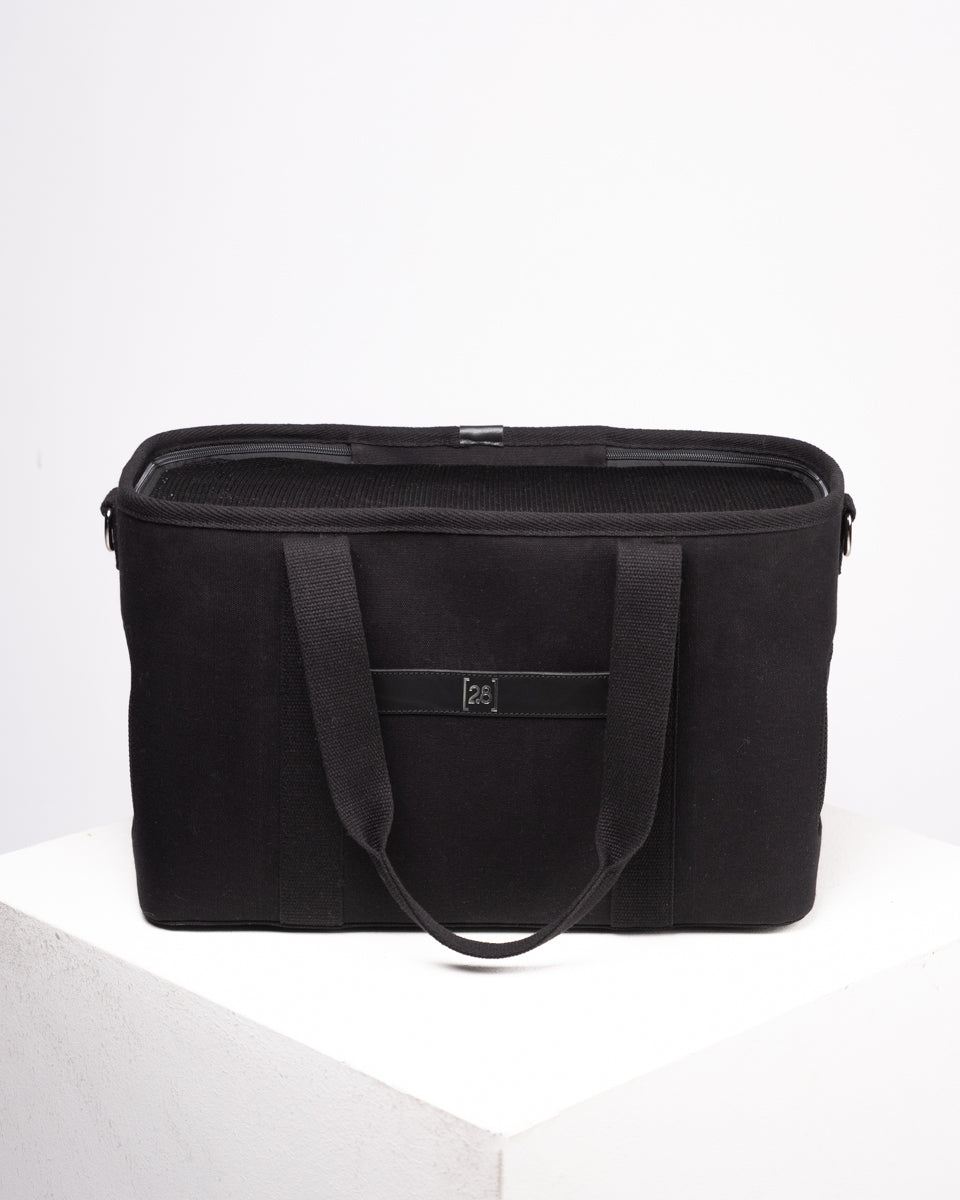
Robert, the 2.8 airline carrier
Robert is made in Italy in a dense, heavily worked cotton that holds its shape without a metal frame. It weighs 1.55 kg (3.4 lb).
Through the airport Robert is carried upright, so the dog can sit with its head up. Under the seat it can stay upright or be turned on its side. On its side it is 24.5 cm (9.6 in) high instead of 28 cm (11 in), 3.5 cm lower, for aircraft with less space under the seat. The mat inside moves with it, along the side.
- Upright: 44 × 24.5 × 28 cm (17.3 × 9.6 × 11 in)
- On its side: 44 × 28 × 24.5 cm (17.3 × 11 × 9.6 in)
- Mesh on the sides and across the top
- An internal strap to clip to the dog's harness
- A reversible mat, bouclé on one side for winter and cotton on the other for summer
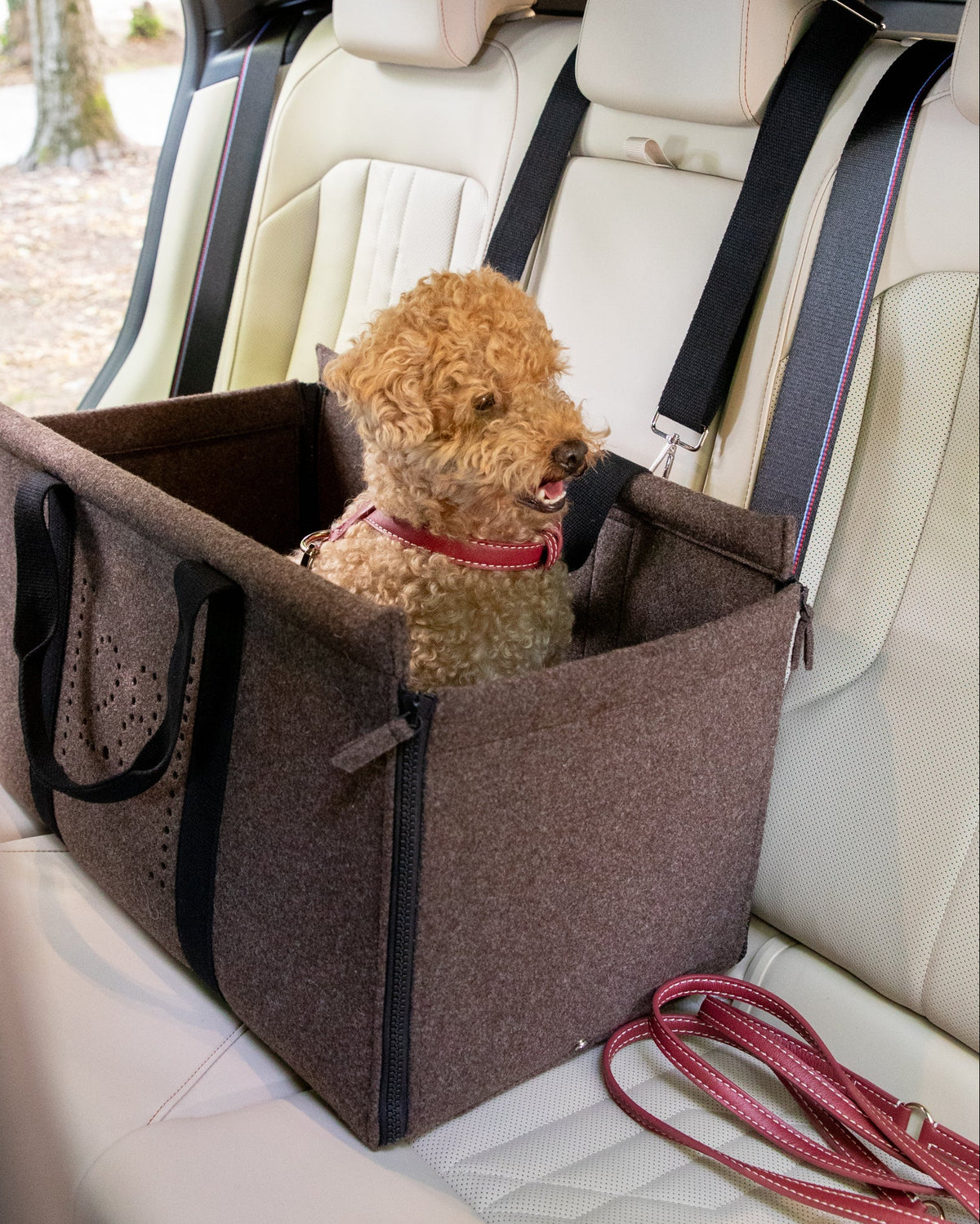
- A front pocket for documents and the pet passport, a sleeve for a suitcase handle and a shoulder strap that also fastens to a car seat
Before you book, compare both sets of measurements with your airline's current limits for your flight.
For the days after landing, Gianni works as a bag, a car seat and a travel mat. More on routine, mats and walking on the road is in our guide to traveling with your dog, and the full travel collection is here.
Frequently asked questions
Can my dog fly in the cabin?
If it fits comfortably in a carrier that goes under the seat in front of you and stays within the airline's limits, usually yes. Each airline sets its own limits for size and weight.
Does the weight limit include the carrier?
Often it does. Check how your airline states it, and weigh the dog and the carrier together.
Soft or rigid carrier?
It depends on the airline. Some ask for a soft carrier, others accept both. Check your airline's wording before you buy or book.
Can my dog come out of the carrier during the flight?
No. The dog stays in the closed carrier, under the seat, for the whole flight.
How early should I prepare the documents?
A few weeks ahead at least. Some requirements, such as a rabies vaccination, involve waiting periods before travel.