
Dog Collar vs Harness: Which Is Right for Your Dog?
This question gets framed as a debate, but it isn't really one. Collars and harnesses serve different purposes, and for many dogs the right answer is both — a collar worn throughout the day and a harness used for walks. Understanding what each does, and when each is the better choice, is more useful than picking a side.
What a collar does
A collar is the most fundamental dog accessory. It's where ID tags live, where an AirTag sits, and for most dogs, it's something they wear all the time — not just on walks. It's part of how a dog is identified, and for many owners it's a considered part of how their dog looks day to day.
For dogs that walk calmly on a leash without pulling, a flat collar is a perfectly appropriate walking tool. The leash attaches to the collar, pressure is minimal, and the walk goes without incident. Many well-trained dogs go their whole lives walking comfortably on a collar with no issues.
Where a collar becomes a less suitable choice for walking is when the dog pulls. Pressure from a collar concentrates on the throat and neck — which, in a dog that pulls consistently, can over time cause irritation and in some cases more serious issues, particularly in small breeds and brachycephalic breeds (French Bulldogs, Pugs, Bulldogs and similar) whose airways are already naturally compressed. For these dogs, a harness isn't just a preference — it's the responsible choice.
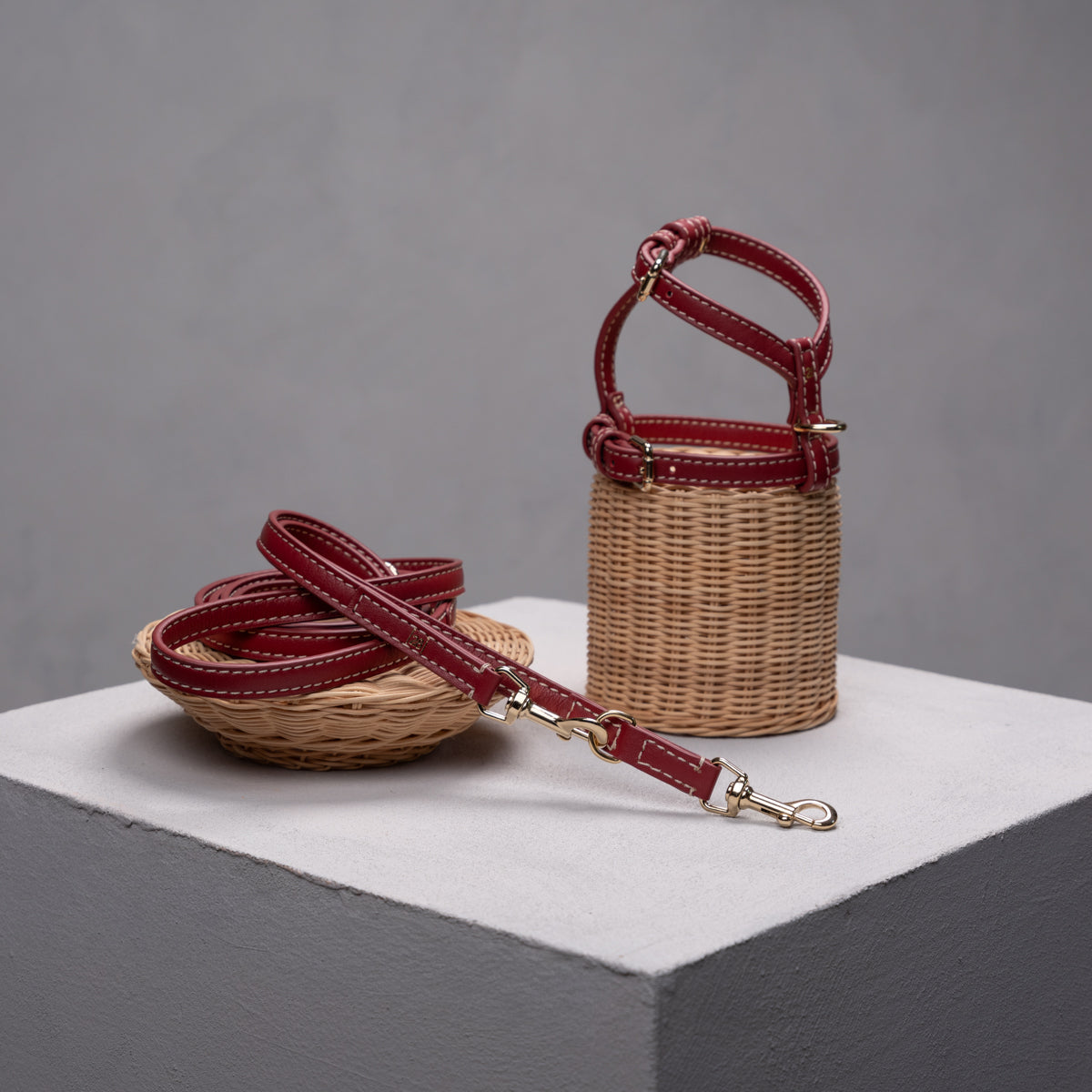
The Ferdinando braided leather collar is designed as a daily wear piece — handmade from Italian nappa, built to last, and available with a matching leash for dogs that walk well on one. The Ugo AirTag holder attaches directly to it, which means even dogs that walk on a harness often wear the Ferdinando collar throughout the day for ID and tracking purposes.
What a harness does
A harness distributes the pressure of the leash across the chest and shoulders rather than the throat. For dogs that pull — or dogs whose anatomy makes neck pressure a concern — this is a meaningful difference.
Vets and trainers broadly recommend harnesses for pullers, for brachycephalic breeds, and for small breeds prone to tracheal sensitivity. This is well-established guidance and worth taking seriously. If your dog pulls on the leash, a harness is the more appropriate walking tool regardless of breed.
Beyond the safety argument, harnesses also give owners more control over larger or stronger dogs, and front-clip harnesses in particular can help redirect pulling behaviour over time. They're not a substitute for training, but they make walks more manageable while training is ongoing.
The tradeoff is practicality: a harness takes slightly longer to put on and take off than a collar, and not all dogs love the process of being fitted at first. Most adjust quickly with repetition.
Choosing between harness styles — Mario, Gabriele and Franco
Not all harnesses are designed the same way, and the distinction matters both for fit and for your dog's size.
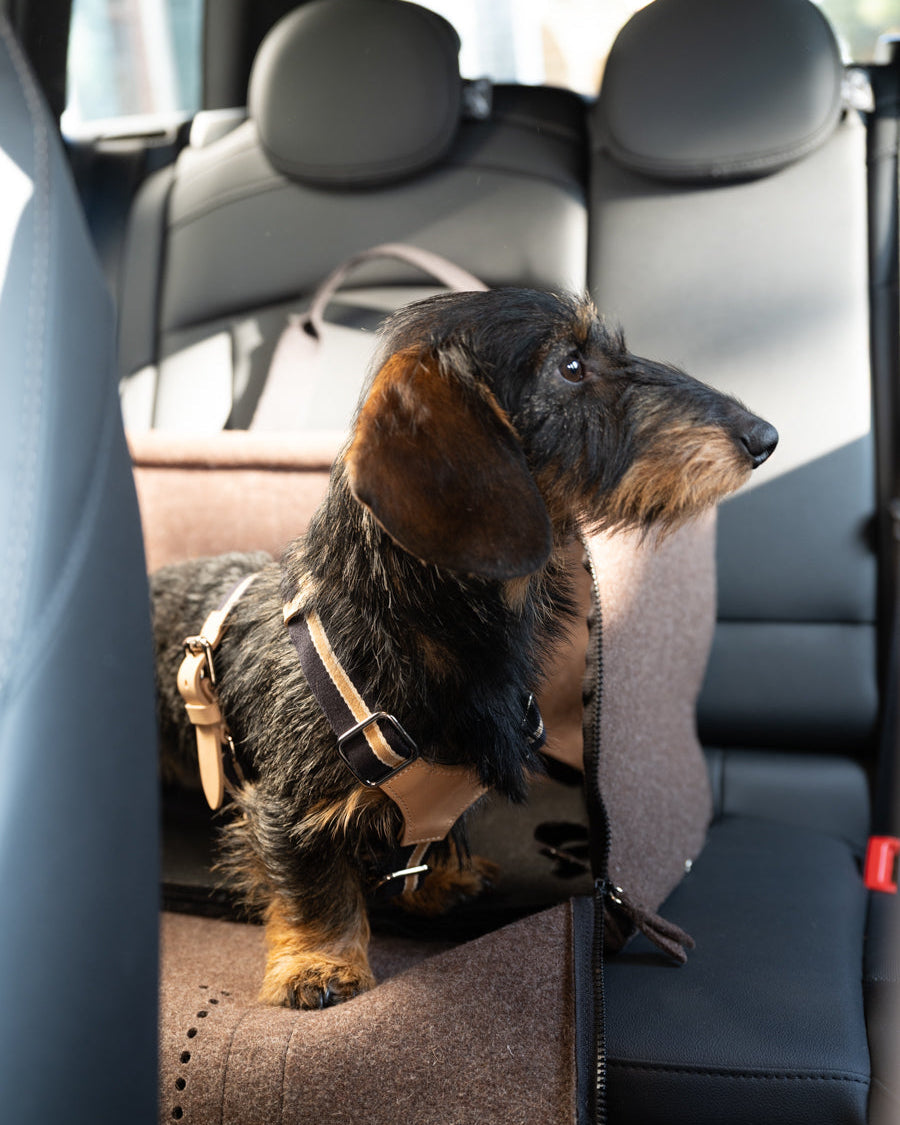
The Mario leather harness is a step-on design — the dog steps in and you clip it closed. No threading through straps, no wrestling at the door. It's lightweight, made from soft Italian nappa, and the most practical option for owners who do multiple walks a day and want the process to be quick. It suits small and medium dogs, up to approximately French Bulldog size.
The Gabriele harness takes a different approach. Its H-shape configuration is widely regarded as one of the most anatomically sound harness designs: pressure is distributed symmetrically, the shoulders are left fully free to move, and the two adjustable buckles allow for a precise fit across varying body shapes. For dogs between sizes, or dogs with a less standard build, that adjustability makes a real difference to comfort. It has a slightly more formal appearance than the Mario and pairs with a crossbody leash designed to be worn across the shoulder. Like the Mario, it suits small to medium dogs.
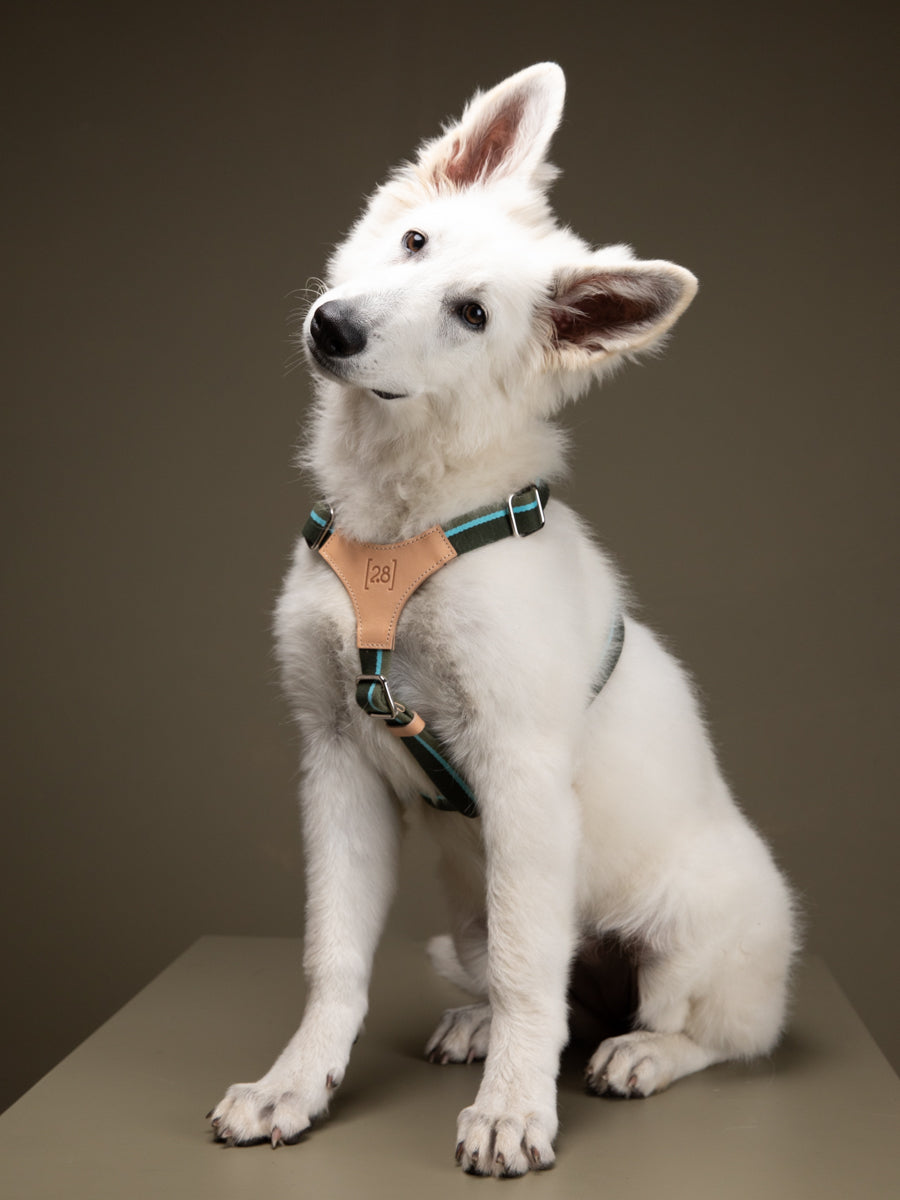
For medium to large dogs, the Franco harness in ribbon and leather is the right choice — and the only 2.8 harness designed for larger builds (neck size from 38cm). It's a Y-shape configuration, which keeps the chest and shoulders open and gives larger, more active dogs full freedom of movement. Unlike the Mario and Gabriele, it's made from striped cotton ribbon with natural leather ends — lighter than full leather, which makes sense for bigger dogs where weight matters more. The leather ends darken with use, developing the same patina quality as the rest of the leather range. It comes in blue stripes and green stripes and pairs with the Franco leash.
All three harnesses are handmade in Italy. The choice between them is primarily about your dog's size and your preference for construction:
- Small to medium dog, priority on speed and simplicity: Mario
- Small to medium dog, priority on adjustability and precise fit: Gabriele
- Medium to large dog: Franco
The case for wearing both
For many dogs, the collar vs harness question resolves itself: they wear both, but for different purposes.
The collar stays on throughout the day — it carries the ID tag, the AirTag holder, and it's part of how the dog presents. The harness goes on for walks and comes off when you're back home. Neither is redundant. They're doing different jobs.
This is a particularly practical approach for dogs that pull or have breed-related sensitivities — the harness handles the walking load, and the collar handles identification and everyday wear without ever being under tension from a leash.
A note on fit
A poorly fitted harness causes its own problems — chafing, restricted movement, or the dog slipping out of it entirely. The key measurements for a harness are chest circumference and, for most designs, neck circumference. When in doubt, measure both before ordering rather than estimating by weight or breed alone.
A poorly fitted collar is also a concern in both directions: too tight causes discomfort, too loose means the dog can slip out of it. The general guide is two fingers fitting comfortably between the collar and the neck.
Both the Mario and Gabriele harnesses come in multiple sizes, and the Ferdinando collar is fully adjustable — if you're ordering as a gift or are between sizes, the collar's adjustability gives more flexibility than a fixed-size harness.
The short version
If your dog walks calmly on a leash: a collar works well as a walking tool, and a harness is a good option too.
If your dog pulls, is a brachycephalic breed, or is a small breed with tracheal sensitivity: a harness is the more appropriate choice for walks.
If you want to cover both bases — daily wear and walking: a collar for the day, a harness for walks. Most dogs adapt to this quickly and it's the approach that tends to work best long-term.
Explore the full walking range: the Ferdinando collar, the Mario harness, the Gabriele harness, and the Franco harness — all handmade in Italy, and all designed to be used daily and to get better with time.