
The French Bulldog: How to Walk a Dog That Was Not Designed for Walking
The French Bulldog was not bred for endurance. It was bred for company — for the laps of Parisian lace-makers in the 19th century, for small apartments, for the particular pleasure of a dog that fits neatly under an arm and has strong opinions about everything else. It is, by almost any measure, a triumph of companionship over athleticism. And yet here we are, every morning, attempting to walk one. This guide is about doing that well — understanding the breed's anatomy, choosing accessories that suit it, and getting the most out of walks with a dog that approaches exercise with admirable philosophical detachment.
Why the French Bulldog's body changes everything
The French Bulldog belongs to a group of breeds known as brachycephalic — from the Greek for "short head." The flat face, the compact skull, the wide jaw: these are the features that give the breed its unmistakable expression and considerable charm. They are also the features that make a French Bulldog anatomically unlike almost any other dog you might own.
The implications for walking are straightforward. A brachycephalic dog has a shorter airway than other breeds, which means it has to work harder to move the same volume of air. This is why Frenchies snore, why they breathe audibly at rest, and why they overheat faster than most dogs in warm weather. It is also why what sits around their neck during a walk matters more for this breed than almost any other.
The neck of a French Bulldog is short, thick, and muscular — and directly beneath it runs the trachea. Any sustained pressure at that point, from pulling against a collar, concentrates force on exactly the wrong structure. Most veterinary specialists advise that for brachycephalic breeds, the collar should not be the point at which the leash attaches. This is not a marginal concern — it is simply a function of the breed's anatomy, and it has a practical, elegant solution.
The harness: the right tool for the walk
A harness moves the point of contact from the neck to the chest and shoulders — the broad, muscular part of the French Bulldog's body that is well-suited to absorbing the forces of a walk. The difference in the dog's comfort is immediate and audible: a Frenchie walked in a well-fitted harness breathes more freely, moves more naturally, and tires less quickly.
The fit, however, is where most harnesses fail this breed. The French Bulldog has one of the most distinctive body shapes in the canine world: a chest so wide and deep that it regularly requires a medium or large harness on a dog that weighs the same as a small terrier. A harness designed generically for "small breeds" will often sit incorrectly — too narrow across the chest, too tight under the arms, or riding up toward the throat — which reintroduces exactly the pressure it was supposed to eliminate. What a Frenchie needs is genuine adjustability at both the neck and the chest, and a construction that keeps straps away from the armpit and off the throat regardless of how the dog moves.
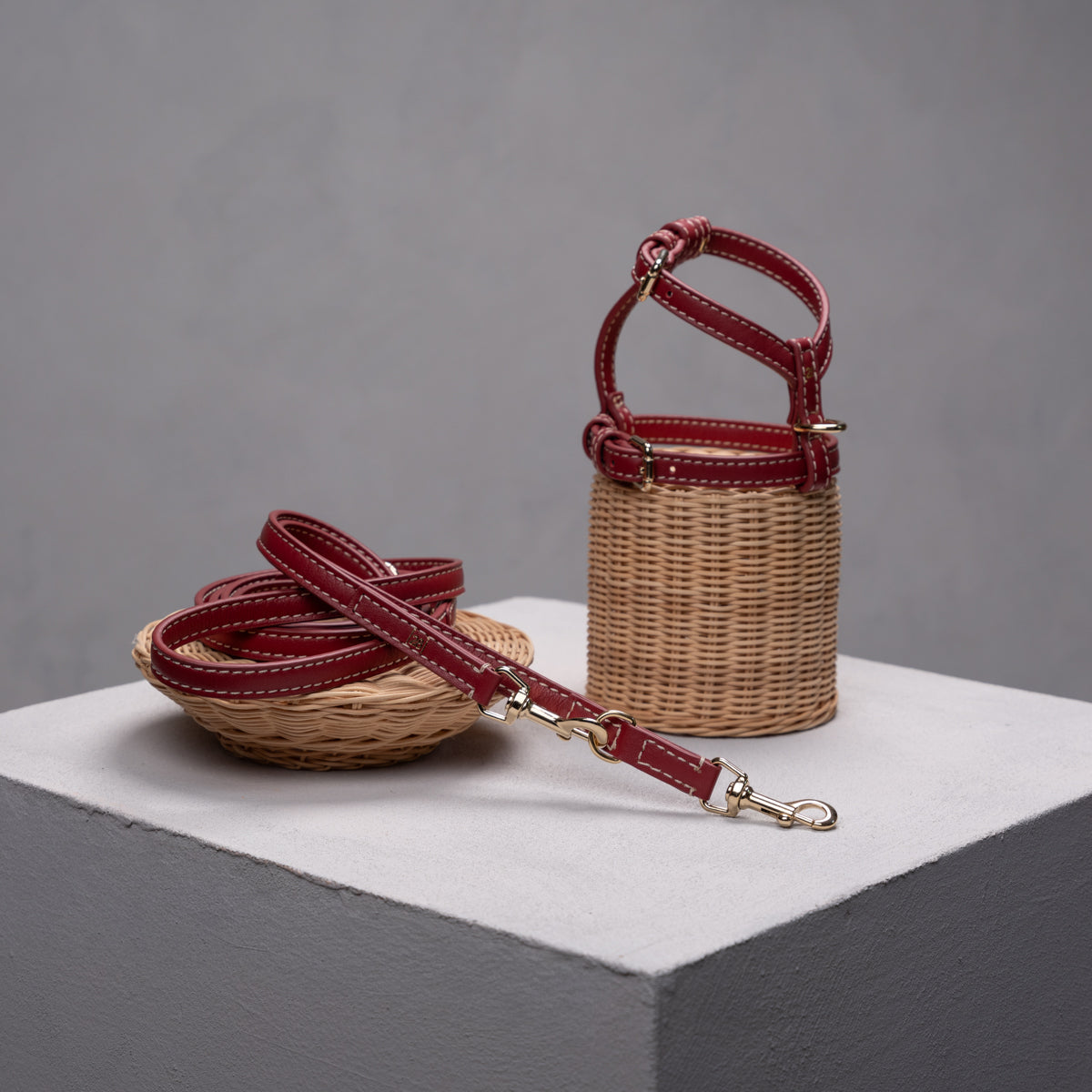
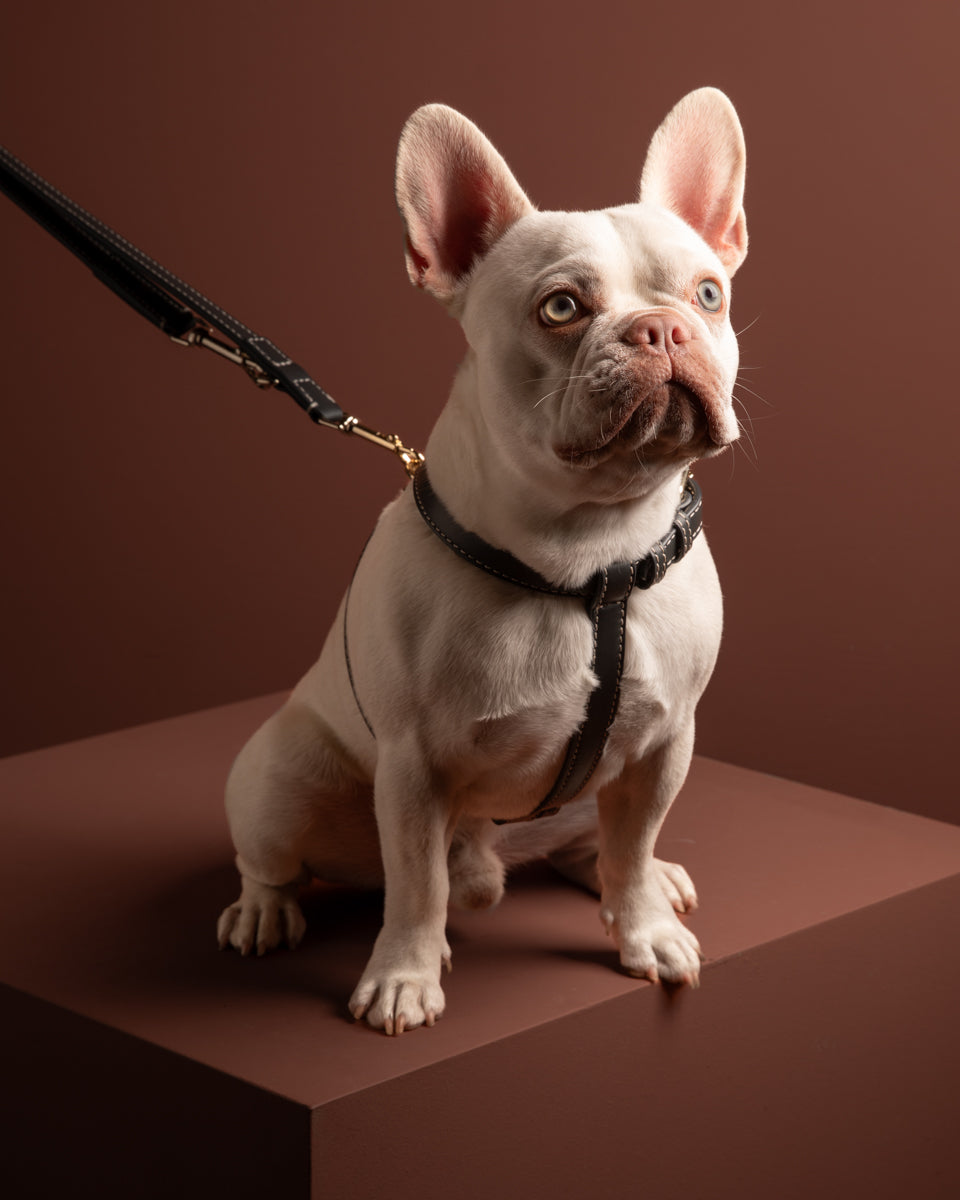
The Gabriele harness addresses this precisely. Handcrafted in Italy from flat Nappa leather — soft enough to sit against the skin without friction, and supple enough to move with the dog rather than against it — the Gabriele features two independent adjustable buckles, allowing the chest and neck fits to be dialled in separately. This matters enormously for a breed where the gap between neck and chest measurements is as wide as it is on a Frenchie. The H-shaped construction distributes contact evenly, leaves the shoulder joints completely free, and keeps all pressure on the sternum — the skeletal structure of the chest — rather than on any soft tissue.
Available in Saddle Brown, Corvine Blue, Cherry and Noir, it pairs with the Gabriele adjustable leash, which extends to 240 cm and can be worn crossbody — a genuinely useful feature for Frenchie owners who have learned that a hands-free configuration is a more relaxed one.
The collar: presence, identity, and daily elegance
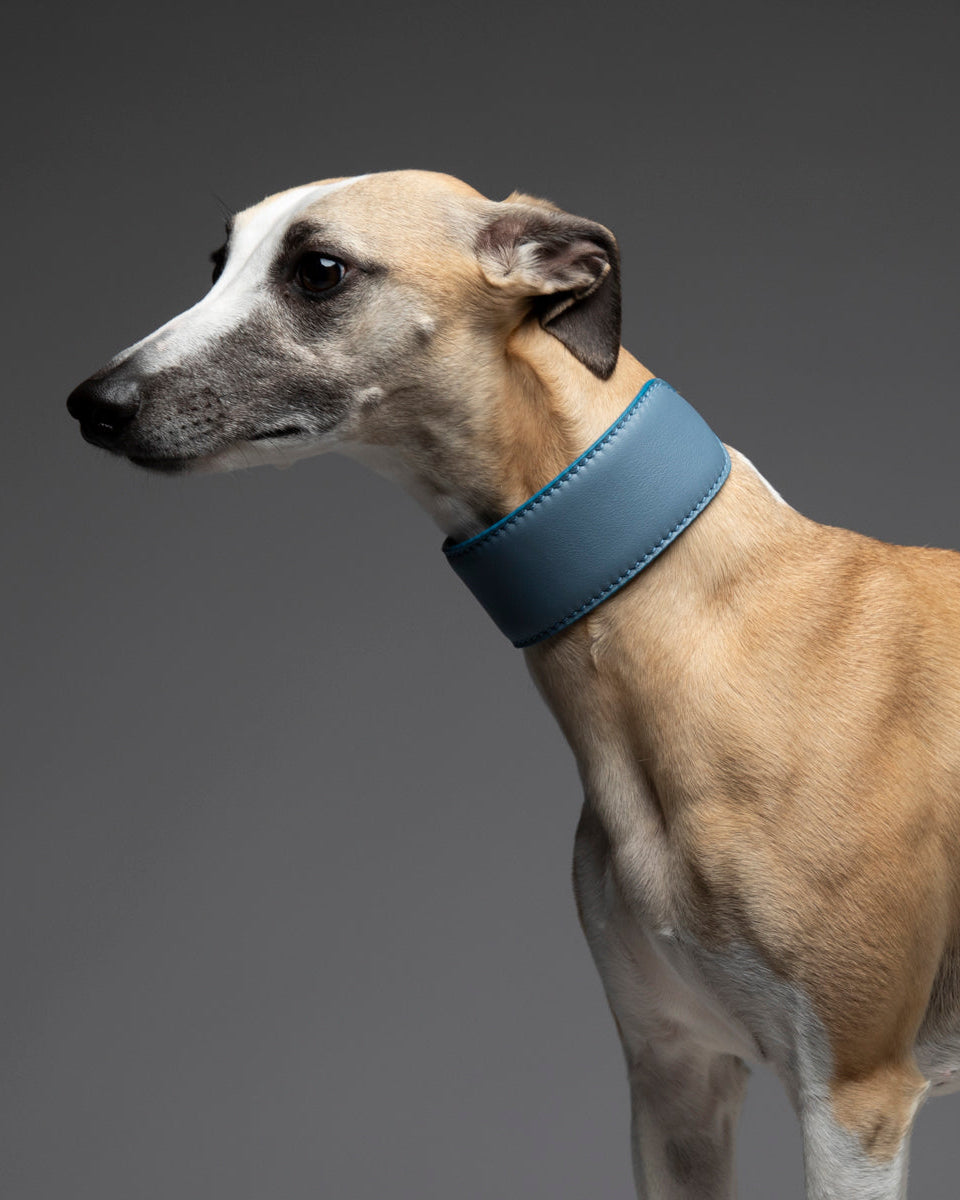
None of the above means a French Bulldog has no business wearing a collar. On the contrary — and anyone who has seen a Frenchie in a beautifully made collar will understand this immediately — few breeds carry one so well. The broad neck, the upright posture, the natural confidence: it is a silhouette that rewards a considered collar.
The collar's role for this breed is simply different from its role for others. It is not the walking attachment — that belongs to the harness — but it is the constant: the thing the dog wears throughout the day, that carries the ID tag, and that forms a considered part of how the dog presents itself to the world. For this purpose, a collar worn correctly at rest, soft enough for all-day comfort and proportioned to the neck, is perfectly appropriate and genuinely worth getting right.
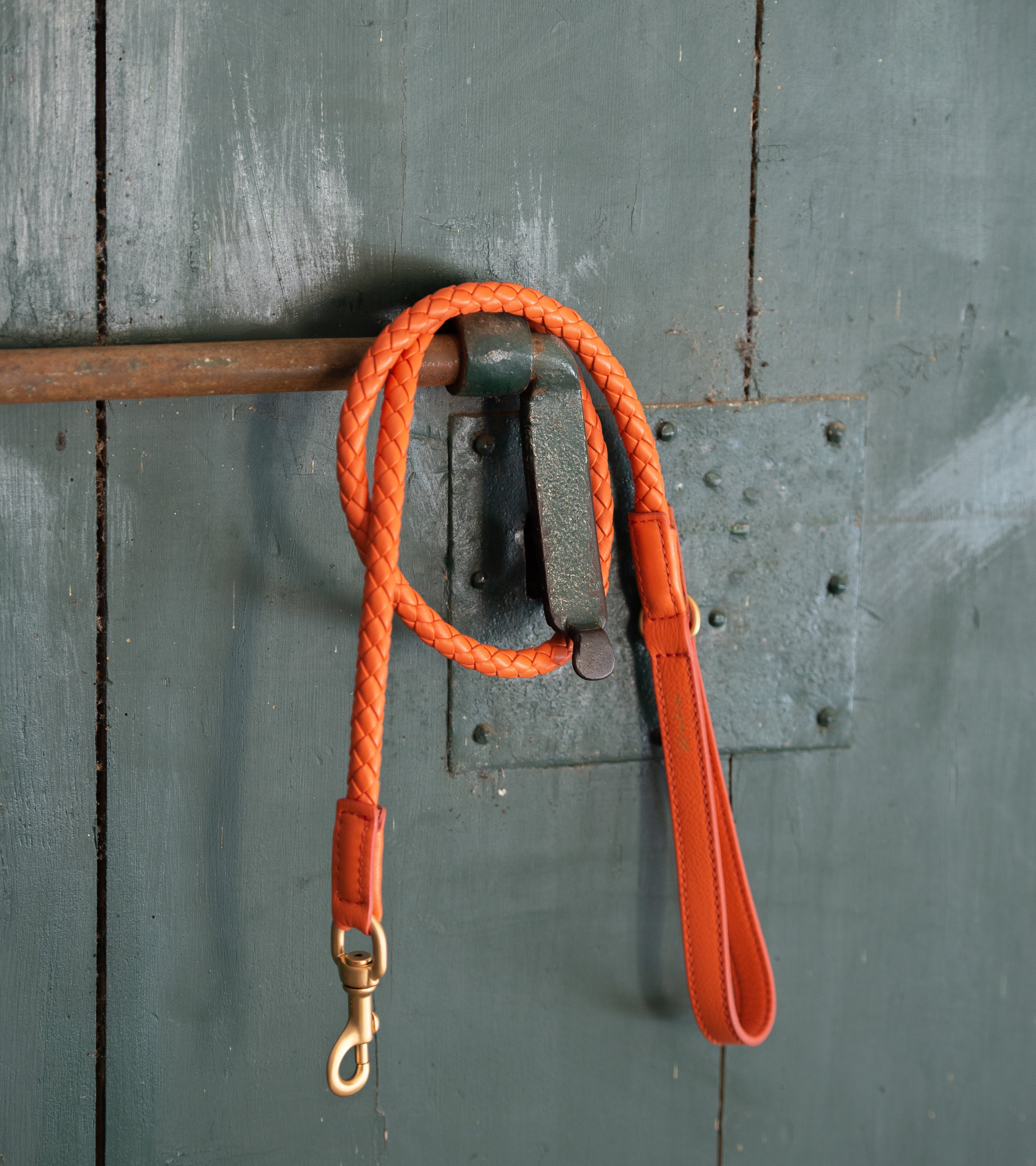
The Ferdinando braided collar works well for exactly this use. Its rounded cross-section in vegetable-tanned Nappa leather sits gently against the coat without the edge pressure of a flat collar, the braid width is scaled to each size, and the gold hardware sits quietly and well against any coat colour. Paired with the Ferdinando leash for those calmer moments — a short walk to a café, a quiet stretch through a park — it completes the picture.
Getting the fit right: measuring a French Bulldog
Sizing a French Bulldog is one of the more counterintuitive exercises in dog ownership. These are dogs that weigh between 8 and 14 kg, but whose chest circumference regularly puts them into harness sizes designed for much larger breeds. Do not size by weight.
For the harness, the critical measurement is chest circumference — taken at the widest point of the chest, just behind the front legs. For the collar, measure the neck circumference at its midpoint, where the collar will actually sit. On a Frenchie, these two measurements will often be further apart than you expect. Both the Gabriele harness and the Ferdinando collar are sized to accommodate the breed's proportions — but measuring carefully before selecting a size will always give a better result than estimating.
A note on walks themselves
The French Bulldog is not a distance breed. It is not built for long runs, hot afternoons, or sustained exertion — and it will tell you so, clearly and without embarrassment, at whatever point it decides the walk is over. Short, frequent walks in cooler parts of the day suit the breed far better than longer outings, and a Frenchie that is walked in properly fitting equipment will always cover more ground more comfortably than one that is not.
There is something to be said for a dog that has negotiated a reasonable relationship with exercise — enthusiastic enough to make a walk enjoyable, sensible enough to know when it is done. The French Bulldog has, in this respect as in many others, arrived at a position most of us are still working towards.
Explore the full walking collection — collars, leashes, harnesses, and coordinating accessories — at duepuntootto.com.