
Luxury Dog Beds That Don't Ruin Your Interior
Most people approach a dog bed as a furniture problem in reverse: they choose something first and then spend months making excuses for it. It ends up pushed into a corner, covered with a throw, or quietly migrating toward the least-visible wall in the room.
This is the wrong order of operations.
A dog bed is not an accessory. It occupies floor space, it carries texture and colour, and — because dogs are creatures of habit — it stays in one place. By every reasonable definition, it is a piece of furniture. The moment you treat it as one, the whole exercise becomes considerably easier.
What follows is a practical guide to integrating a luxury dog bed into your home with the same intention you would bring to any other interior decision. Not as a compromise. As a choice.
Start with the room, not the bed
The most common mistake is beginning at the product page and working backwards. Before looking at any bed, spend a few minutes with the room it will live in.
What are the dominant materials? A room anchored by dark oak floors and linen upholstery has different requirements than one built around polished concrete and sheepskin throws. What is the existing textile story — are there woven textures, smooth surfaces, a mix? What colours already have a role, and is there a tone that currently has no physical object to its name?
A dog bed that answers one of those questions — that completes a palette, that introduces a texture that was missing, that grounds a corner that floated — is not a compromise. It is a considered addition. The same bed placed without that thinking will always look like it arrived from somewhere else.
The discipline here is treating the purchase as an interior decision rather than a pet supply errand. The former narrows the field considerably, in a useful way.
Material is the primary connective tissue
More than colour, more than shape, it is material that determines whether a dog bed belongs in a room or merely occupies it. This is because the eye reads textural family before it registers colour. A bouclé bed in a room full of smooth surfaces will always create tension, regardless of how well the colour matches. The reverse is equally true: the right material in the wrong colour reads as far more coherent than the wrong material in the right one.
Some practical guidance by interior register:
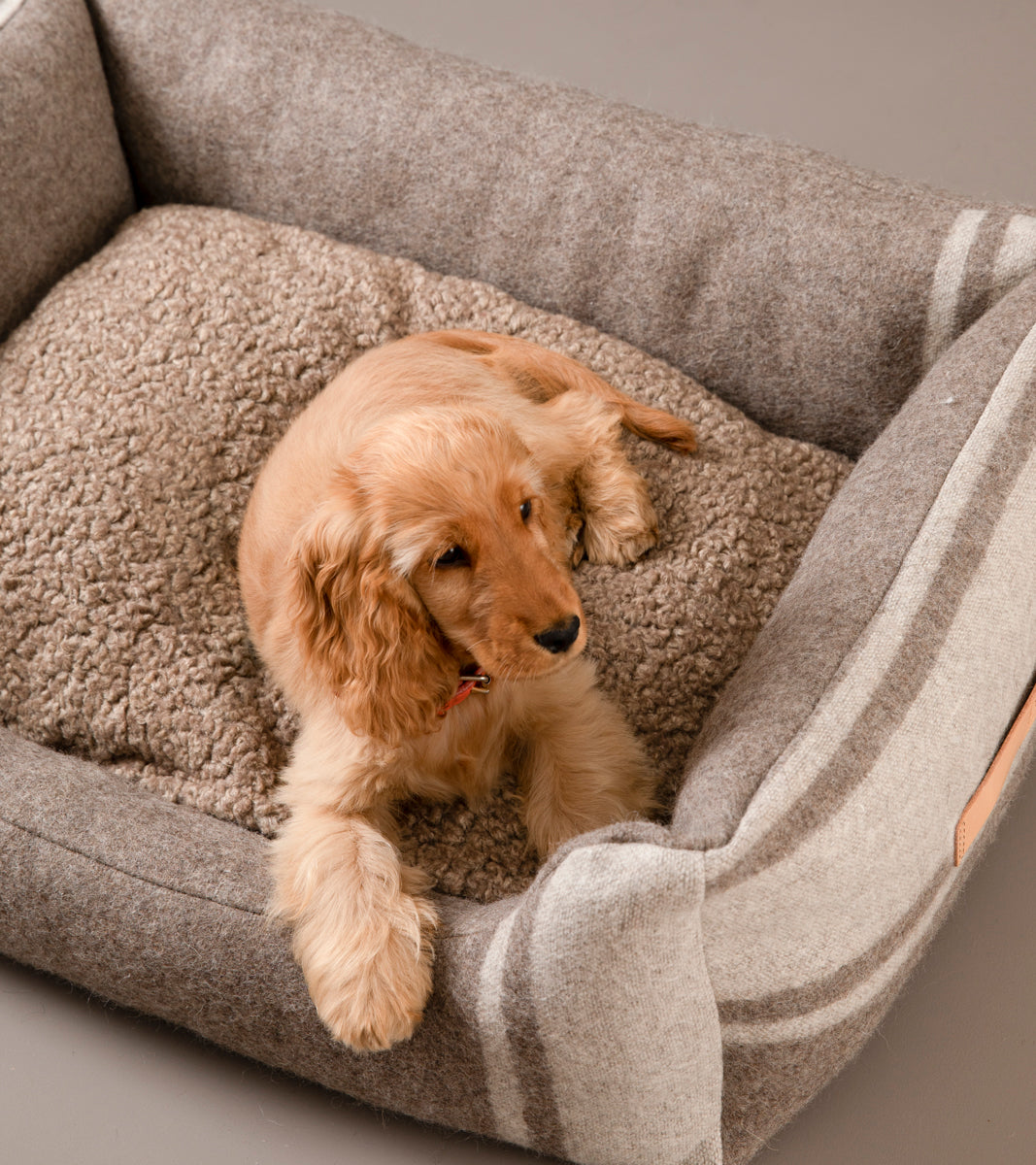
Warm contemporary and Italian-inflected interiors — rooms with a bias toward natural materials, warm neutrals, and textural depth — are natural homes for bouclé. The Fulvio round cushion in bouclé wool sits in these spaces the way a cashmere throw does: it reads as part of the material vocabulary rather than an intrusion into it. The natural and cream colourways in particular have a way of disappearing into a room in the best sense — present without announcing themselves.
Minimalist and Japandi interiors, where the emphasis is on honest materials and visual restraint, are well served by linen, jute, and undyed organic cotton. The Henri in Jute — in Ecru or its warm neutral variants — carries the same logic as bare oak or unbleached linen: it doesn't try to be more than it is, which is exactly the point. Nothing in a well-edited minimalist room should require justification, and this bed doesn't.
Homes with a more artisanal or heritage character — exposed brick, antique rugs, patinated surfaces — can absorb materials of greater visual weight. The Henri in Casentino wool is worth knowing about here: Casentino is a Renaissance-era Tuscan fabric, still woven in the hills above Arezzo, naturally water-repellent and available in the kind of saturated, warm tones that feel at home next to old things. It is a bed with genuine material provenance — and in the right room, that specificity reads.
Eclectic or more maximalist interiors, where layering and visual richness are the point, have more latitude. The Henri in full grain leather — Italian-tanned, with the natural variation you would expect from a hide — sits in these rooms the way a worn leather chair does: as something that has earned its presence through material honesty rather than decorative effort.
The colour question — three approaches that work
Once you have settled on material, colour is the second decision. There are three coherent strategies, each valid:
Tone-on-tone. Choose a bed in a slightly darker or lighter version of your dominant wall or floor colour. This is the quietest approach — the bed recedes into the room and the effect is one of considered calm rather than visible coordination. It works particularly well in neutral rooms where the goal is cohesion rather than contrast.
Coordinate to an existing accent. Pick up a colour that already appears elsewhere in the room — in a cushion, a ceramic, a piece of art — and use the bed to give it a larger surface area. This is how interior designers think about colour distribution: a tone that appears in multiple objects, at different scales, creates a sense of intention. The Henri in Canvas Cotton covers enough of the colour spectrum — Dove grey, Petrol blue, Ochre, Anthracite — that one of its tones is likely to already exist somewhere in your room. Find it, and the placement becomes obvious.
Deliberate contrast. In a room that is largely neutral, a single piece in a considered colour can function as an anchor — the same role a coloured sofa or a dark side table plays. This requires more confidence but, done well, produces the most resolved result. The key is choosing a colour with existing interior credentials: warm mustard, deep charcoal, muted petrol. Not bright, not primary. The distinction matters.
Placement: give your dog a zone, not just a spot
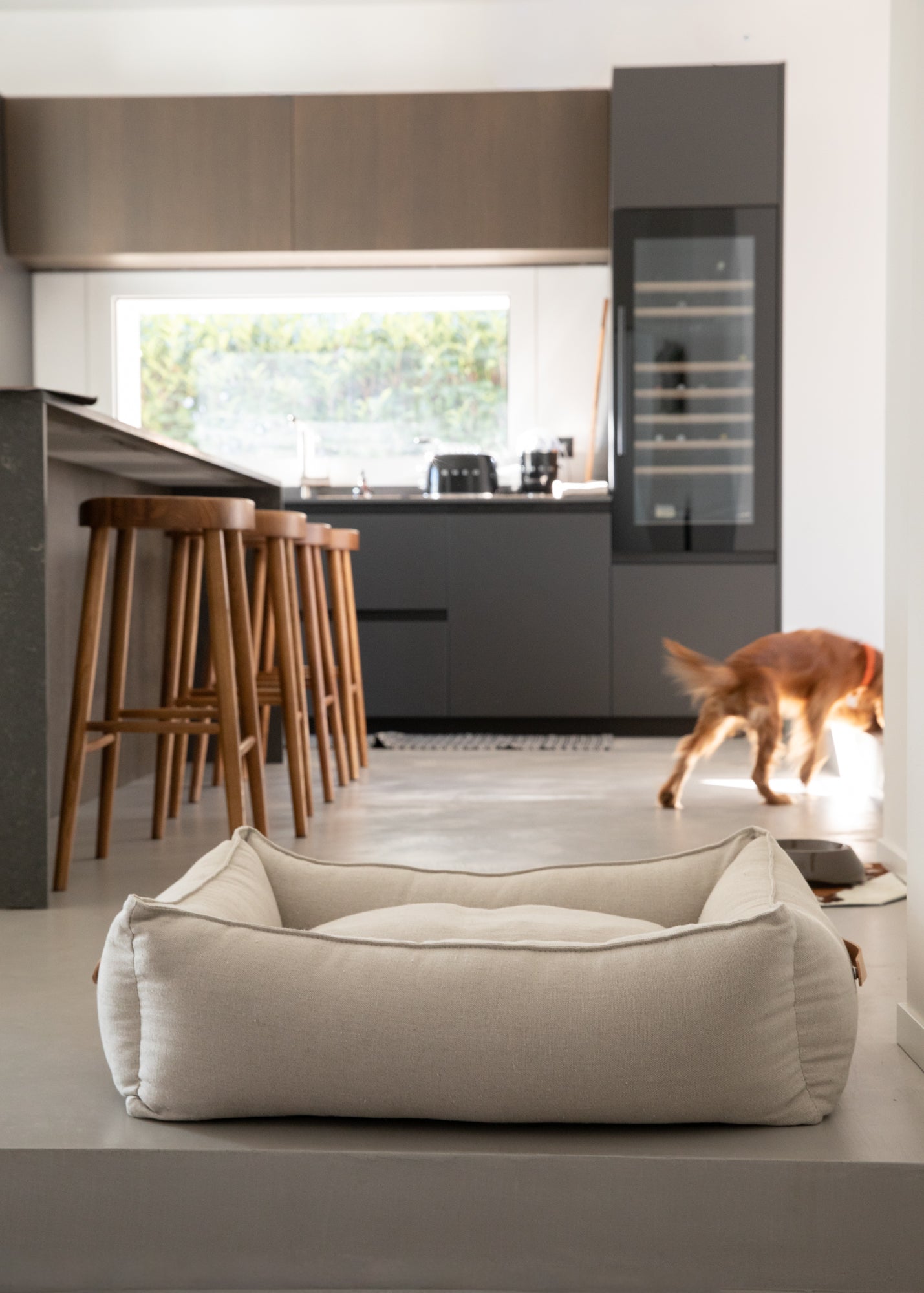
Where a bed goes is as important as what it looks like. A bed placed in the middle of a room — or pushed against a wall without context — will always look provisional, whatever it is made of. The goal is to give the dog a zone: a defined space that reads as intentional rather than incidental.
The most reliable approach is to anchor the bed to a piece of existing furniture. Positioned beside a sofa, it reads as part of a sitting area. Placed in an alcove or recessed corner, it becomes a destination — something that works with the architecture rather than against it. Under a window, it takes advantage of a natural focal point that benefits any object placed beneath it.
Resist the instinct to hide it. A bed placed as though it should not be seen will always communicate that ambivalence. One placed with the same deliberateness as a side table or a floor lamp communicates something different: that the dog is part of the household, and the space has been thought about accordingly. This is, at its core, what the best dog-friendly interiors have in common — they don't apologise for the dog's presence. They accommodate it, and the room is better for it.
Scale: the mistake most people make
The most overlooked variable in choosing a dog bed is its relationship to the room, not just the dog. A small bed in a large room disappears without resolving anything. A large bed in a small room crowds the space and draws attention to itself for the wrong reasons.
The practical rule is this: the bed should be proportional to its surroundings before it is proportional to the dog. If the room can accommodate a 90cm round cushion or a generously sized rectangular bed, that scale will look more resolved than a smaller version of the same object. It registers as a considered element rather than a token gesture.
The Fulvio cushion is available in 70cm and 90cm diameters — a distinction worth paying attention to. In a living room with substantial furniture, the 90cm reads; in a smaller study or bedroom nook, the 70cm has more composure. Neither is automatically correct. Look at the space first.
The case for interchangeable covers
One advantage of the 2.8 approach that is easy to undervalue until you have lived with it: the ability to change the cover.
Both the Henri beds and the Fulvio cushions are built around a removable outer cover system, and interchangeable extra covers are available separately. This matters for two reasons that have nothing to do with washing.
The first is seasonal. A bouclé wool cover in winter reads as warm and considered. In July, in the same room with the windows open and a linen duvet on the bed, it reads as heavy. A lighter cotton canvas cover shifts the register of the same object without requiring a second bed. The inner cushion remains; the exterior adapts.
The second is that rooms change. Paint colours get revisited. Sofas are replaced. A bed you bought to coordinate with a particular palette may find itself stranded by a redecoration. With a fixed cover, the answer is a new bed. With interchangeable covers, it is a more manageable decision — and one that sits better with the idea of buying well once rather than replacing often.
A final thought on what "belonging" actually means
The best outcome for a dog bed in a considered interior is not that it disappears. It is that removing it would leave the room incomplete.
That is the standard worth holding: not invisibility, but belonging. An object that has been chosen with the same care as everything around it, placed with the same intentionality, made from materials that age in the same direction. One that communicates, without effort, that the dog was accounted for in how this room was put together.
That is a different thing from a dog bed that has been tolerated. And the difference is almost entirely in how the decision was made.
Browse the full Sleeping collection — all beds are available in multiple sizes, materials, and colourways, with removable washable covers and the option to personalise with an embroidered name.