
AirTag Dog Collar: The Elegant Way to Add a Tracker to Your Dog's Collar
Ugo has an origin story, and it starts with Hermione.
Hermione is a dachshund — one with strong personal views on which spaces apply to her and which don't. One afternoon, she found a gap in the garden fence and slipped through it. She was following a scent, almost certainly, and was entirely unbothered by the commotion she'd left behind. She was found quickly. Everything was fine.
But the question it left behind wasn't so easy to shake. If it happened again, how long before we found her?
The Apple AirTag is a small, quiet answer to that. A tracker no bigger than a coat button that lives on your dog's collar and asks nothing of you — until the one day you need it. If you've come to the same conclusion, or you're simply the type who prefers to be prepared rather than caught off guard, the only real question left is how to attach one without the whole setup looking like an afterthought.
That's what this is for.
Why Most AirTag Dog Collar Solutions Look Exactly Like What They Are
The Apple AirTag is an elegantly minimal object. A white disc, smooth-edged, about the size of a large coat button. Apple designed it to disappear into daily life — slipped into a bag, tucked into a wallet, placed inside a jacket. It has no sharp corners, no branding aggression, no unnecessary visual noise.
Then it gets attached to a dog collar via a moulded plastic clip in a shade of green that exists nowhere in nature, and the spell is broken.
This is not a trivial concern. If you have invested in a considered walking set — a collar and leash chosen for quality, material, and how they look on your dog — a cheap AirTag holder is not a small detail. It is the equivalent of pairing a made-to-measure coat with a neon lanyard.
The market for AirTag dog collar attachments is, unfortunately, dominated by products designed to be inexpensive rather than good. They are made from plastic or low-grade silicone, they bulk out the collar, and most of them hold the AirTag with approximately the same confidence as a toddler holding a grape.
Which means the choice of holder is not cosmetic. It is structural.
What to Actually Look for in an AirTag Collar Holder
Before shopping, it helps to know what matters. There are four things worth checking:
Security. The AirTag should not be able to fall out during normal activity — running, swimming, rolling, or whatever your dog considers a reasonable Tuesday. A holder that relies on friction alone is not a holder; it is a countdown.
Weight and profile. Dogs notice what's on their collar. A bulky, heavy holder that shifts and catches is a distraction at best, an irritant at worst. The ideal holder adds almost nothing — in weight and in visual presence.
Material compatibility. If your collar is leather, a leather holder reads as intentional. If your collar is leather and your holder is glossy polycarbonate, one of them looks wrong. (It's the polycarbonate.)
Replaceability. The AirTag battery lasts roughly a year. The holder needs to allow for easy access without requiring a toolkit or a degree in lateral thinking.
Your Options for Attaching an AirTag to a Dog Collar
Not all attachment methods are equal. Here is an honest look at what's available.
Built-in AirTag Collar Slots
Some collars are manufactured with a dedicated AirTag slot integrated into the design. This is the cleanest solution visually, but it commits you to a specific collar and limits your flexibility if you want to change the aesthetic later. It also tends to limit the collar's adjustability.
Silicone or Plastic Clip-On Holders
The most common and, bluntly, the least considered option. They work in a functional sense, but they are designed to be cheap to produce, not to last or to look like anything in particular. Fine as a temporary solution; less fine if you are still using the same one three years later.
Leather Loop Holders
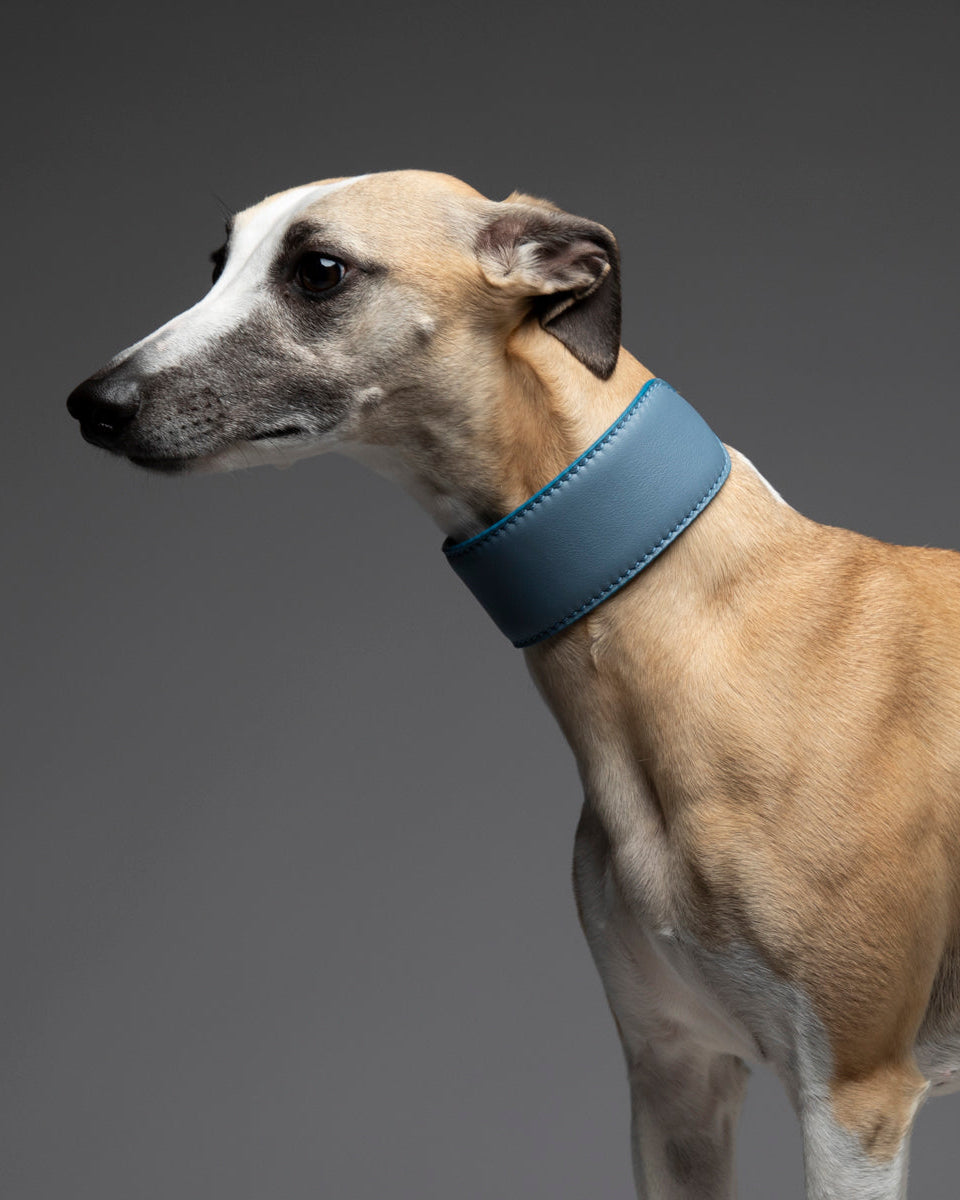
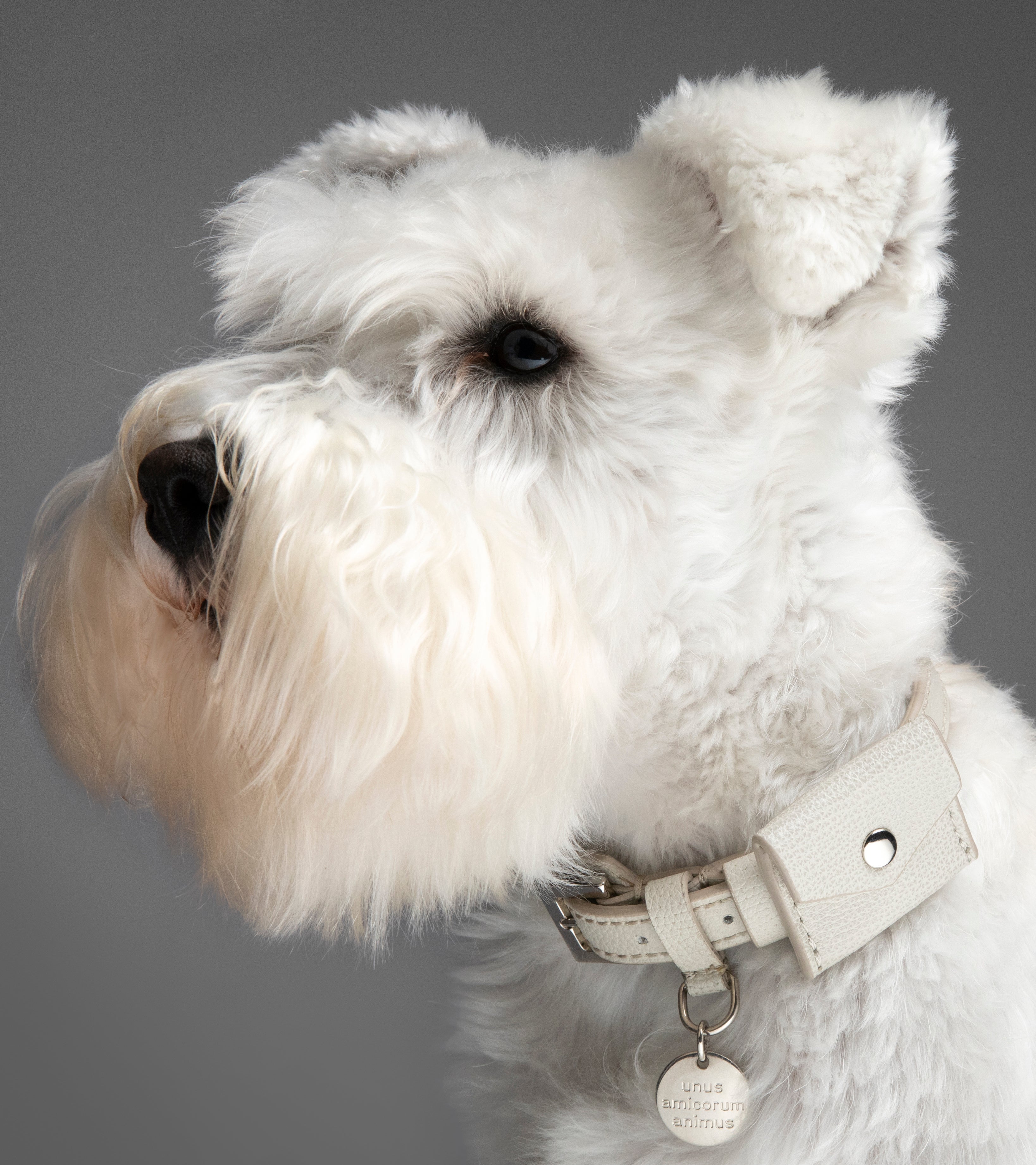
The approach most worth considering: a small leather pouch or case, designed to loop onto the collar or harness, that holds the AirTag securely while reading as a natural extension of the collar itself. When made from the same leather and in the same finish as the collar, it becomes part of the set — rather than something added onto it.
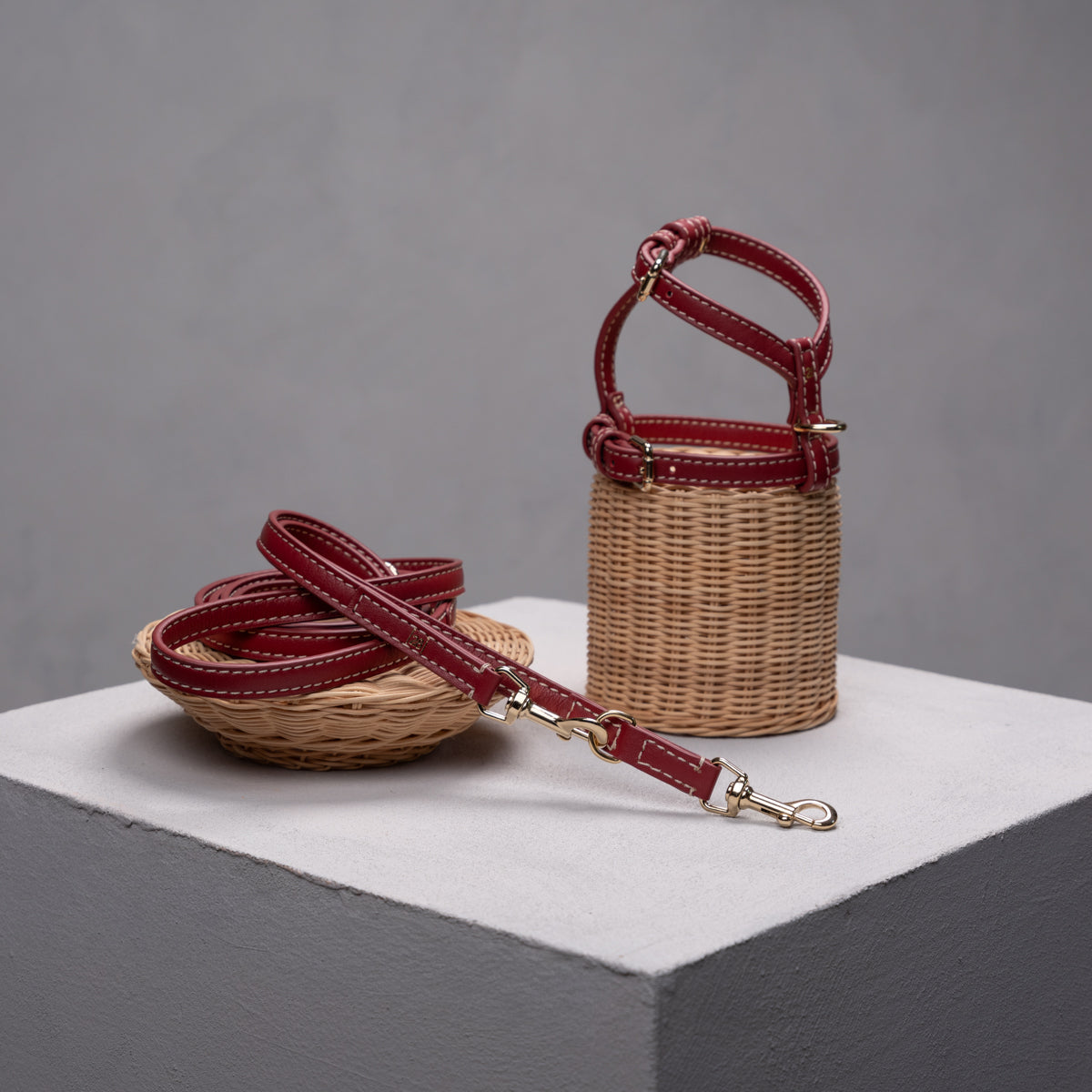
This is the thinking behind Ugo, the 2.8 AirTag holder. Made in nappa leather and coordinated with the Ferdinando collar series, Ugo is a compact 4.5 × 4.5 cm pouch with a snap-button closure and a rear loop that attaches directly to any collar or harness. Same material, same palette, same stitching as the rest of the walking set — handmade in Italy, as everything else is.
The result is a collar that carries a tracker the way a good watch carries a date complication: you know it's there. You'd notice if it wasn't. But it doesn't announce itself.
Does the AirTag Actually Work on a Dog Collar?
Yes, with a caveat worth understanding.
The Apple AirTag works through Bluetooth and the Find My network — which means it relies on proximity to other Apple devices to report its location. In a city, this is highly effective. In a rural or remote area with very few Apple devices nearby, the network is thinner and updates are less frequent.
This does not make it useless in the countryside. It means that in a remote area, the AirTag's last known location may be a few minutes behind the present one. When a device does get close enough, the AirTag's Precision Finding — which guides you directly to the object — works exactly as advertised.
For most dog owners, in most contexts, it is a very good solution. For those in particularly remote areas, a GPS collar with live tracking may offer more reassurance (at considerably greater expense and with a battery that needs charging every day or two).
The two are not mutually exclusive. An AirTag as a passive, always-on backup layer, combined with a GPS collar for long off-lead walks in the open, is a perfectly rational approach.
AirTag Dog Collar: The Practical Setup
Once you have the right holder, the setup takes minutes:
- Activate the AirTag in the Find My app on your iPhone or iPad before attaching it to the collar.
- Name it — use your dog's name, not "AirTag 3." You'll thank yourself later.
- Attach the holder to your dog's collar. If using a loop-style holder, thread it onto the collar before the clasp is attached; if it uses a D-ring clip, attach it to the existing hardware.
- Click the AirTag in. It should seat firmly — you'll feel it lock into place.
- Test the location before you leave the house. Open Find My, confirm the AirTag is reporting correctly, and note its last-seen position.
One additional step that is easy to overlook: register your contact information with Apple so that if someone finds your dog and taps the AirTag with their phone, they see how to reach you. This requires no app on their part — any NFC-enabled smartphone can read it.
Frequently Asked Questions
Is the Apple AirTag safe for dogs to wear? Yes. The AirTag emits a very low level of Bluetooth signal and poses no risk to dogs. The main practical concern is ensuring the holder keeps it secure and that the AirTag itself doesn't become a chew toy if the dog manages to get it off — the battery inside is small and should not be ingested.
Can the AirTag get wet? The AirTag has an IP67 rating, which means it can be submerged in up to one metre of water for up to 30 minutes. For most dogs — rain, puddles, the occasional ill-advised swim — this is more than adequate. The holder should be made from a material that also handles moisture well; vegetable-tanned leather, for example, benefits from occasional conditioning if it gets wet regularly.
How long does the AirTag battery last? Approximately one year, depending on usage. Apple uses a standard CR2032 coin battery, which is widely available and easy to replace. A good holder allows access to the back of the AirTag without tools.
Will the AirTag make noise on my dog's collar? No, unless triggered. The AirTag emits a sound only when activated through Find My, or after a period of separation from its owner's device — a safety feature designed to prevent unwanted tracking. In normal daily use, it is silent.
What size AirTag holder do I need? The AirTag has a fixed diameter of 31.9mm and a thickness of 8mm. Any holder designed for Apple AirTag will fit. What varies is the attachment method and how the holder interfaces with your collar — which is why material and design compatibility matters more than size.
A Final Thought
The AirTag is, in the end, a very small insurance policy. One that lives on your dog's collar every day, costs nothing to run after the initial purchase, and — if it ever earns its place — will be the best thing you ever attached to a piece of leather.
It deserves to be attached well.
Ugo was designed to do exactly that — a companion piece to the 2.8 walking set that completes it rather than compromising it. Because a considered collar deserves a considered holder.