
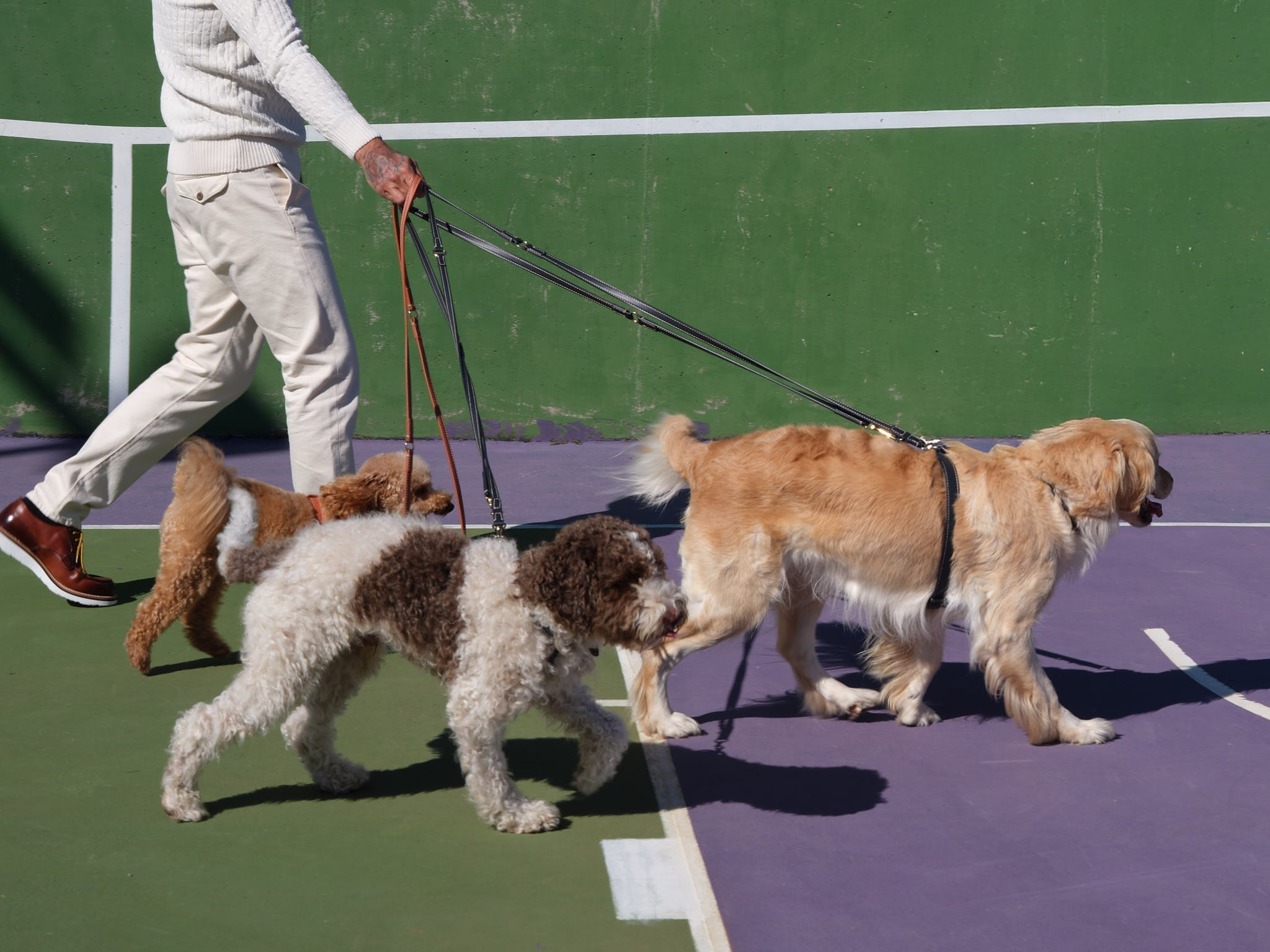
Dog Collar vs Harness: How to Choose
The decision depends on your dog's anatomy, behavior, and health — not on a general rule.
The question comes up constantly, and the honest answer is that neither a collar nor a harness is universally better. Each has specific advantages, and the right choice depends on the individual dog: the breed, the neck structure, the behaviour on leash, and any medical considerations.
This guide works through the variables that actually matter, with specific guidance for common situations — smaller breeds, dogs that pull, brachycephalic dogs, sighthounds, and dogs recovering from neck or back injuries.
When a collar works well
A well-fitted collar is appropriate for most dogs that walk calmly on a leash without pulling. It is simple to put on and take off, comfortable for the dog to wear all day as an ID tag holder, and — if the material is right — unobtrusive during walks.
The key variables in collar selection are width, weight, and material. For small breeds, a collar that is too wide or too heavy for the dog's neck size creates disproportionate pressure and restricts head movement. The recommended width for miniature and toy breeds is 1 to 1.5 cm. For medium and large breeds, a wider flat collar distributes leash pressure across a larger surface area.
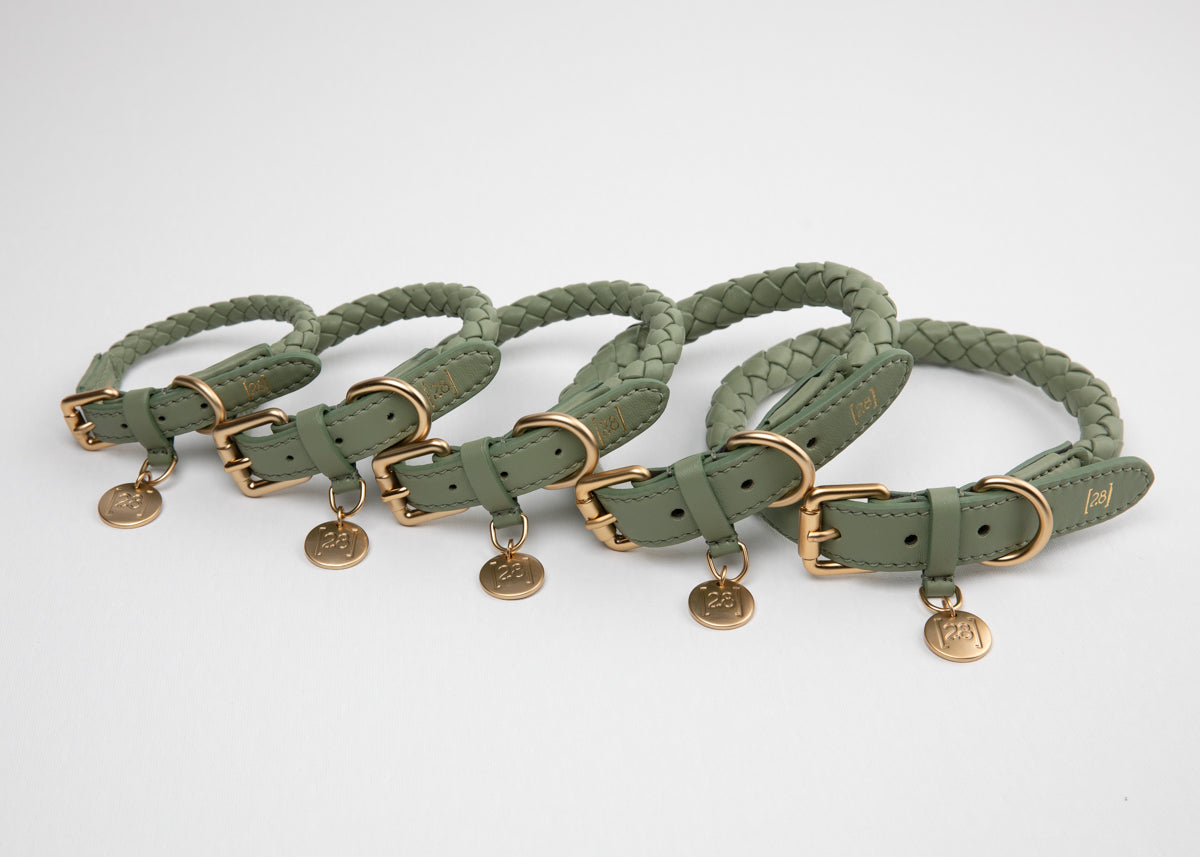
Material matters over time. Nylon remains unchanged through months of use — it does not soften or conform to the neck. Italian Nappa leather, by contrast, becomes more supple with daily wear and gradually shapes itself to the dog's neck. After a month of use, a Nappa leather collar fits more precisely than it did on day one. For dogs with narrow or irregular neck profiles — a category that includes many small breeds and most sighthounds — this conforming quality makes a material difference to daily comfort.
→ Ferdinando – Braided Leather Collar
→ Mario – Flat Padded Leather Collar
When a harness is the better choice
A harness distributes force across the chest and shoulders rather than concentrating it on the neck. For specific dogs and specific situations, this is not a preference — it is medically relevant.
Dogs that pull consistently on leash generate repeated neck strain through a collar. For most healthy dogs, this is not a serious concern with a well-fitted collar and reasonable walk duration. For dogs that pull hard and frequently, redirecting that force to a harness reduces cumulative strain.
For dogs with confirmed tracheal sensitivity, tracheal collapse (a known risk in some toy breeds, particularly Yorkshire terriers, Pomeranians, and Chihuahuas), or cervical disc disease veterinarians consistently recommend attaching the leash to a harness rather than a collar during walks. In these cases, the collar remains useful as an ID tag holder, but should not be the leash attachment point.
Brachycephalic breeds — French bulldogs, pugs, Boston terriers, English bulldogs — have compressed airways and are sensitive to any restriction around the throat. A harness is generally the better daily walking option for these dogs, even when they do not pull.
Sighthounds — greyhounds, whippets, Italian greyhounds, salukis — have a distinctive anatomy: a neck that is often as wide as or wider than their head. Standard collars slip off sighthound necks. A padded flat collar with a wider surface (the Mario greyhound collar is designed for exactly this) or a harness provides more secure fit and better pressure distribution.
The three harness types and what they are for
Not all harnesses are the same. The shape determines how force is distributed and how the dog moves while wearing it. 2.8 makes three harness types, each with a different structure.
Step-in harness (Mario)
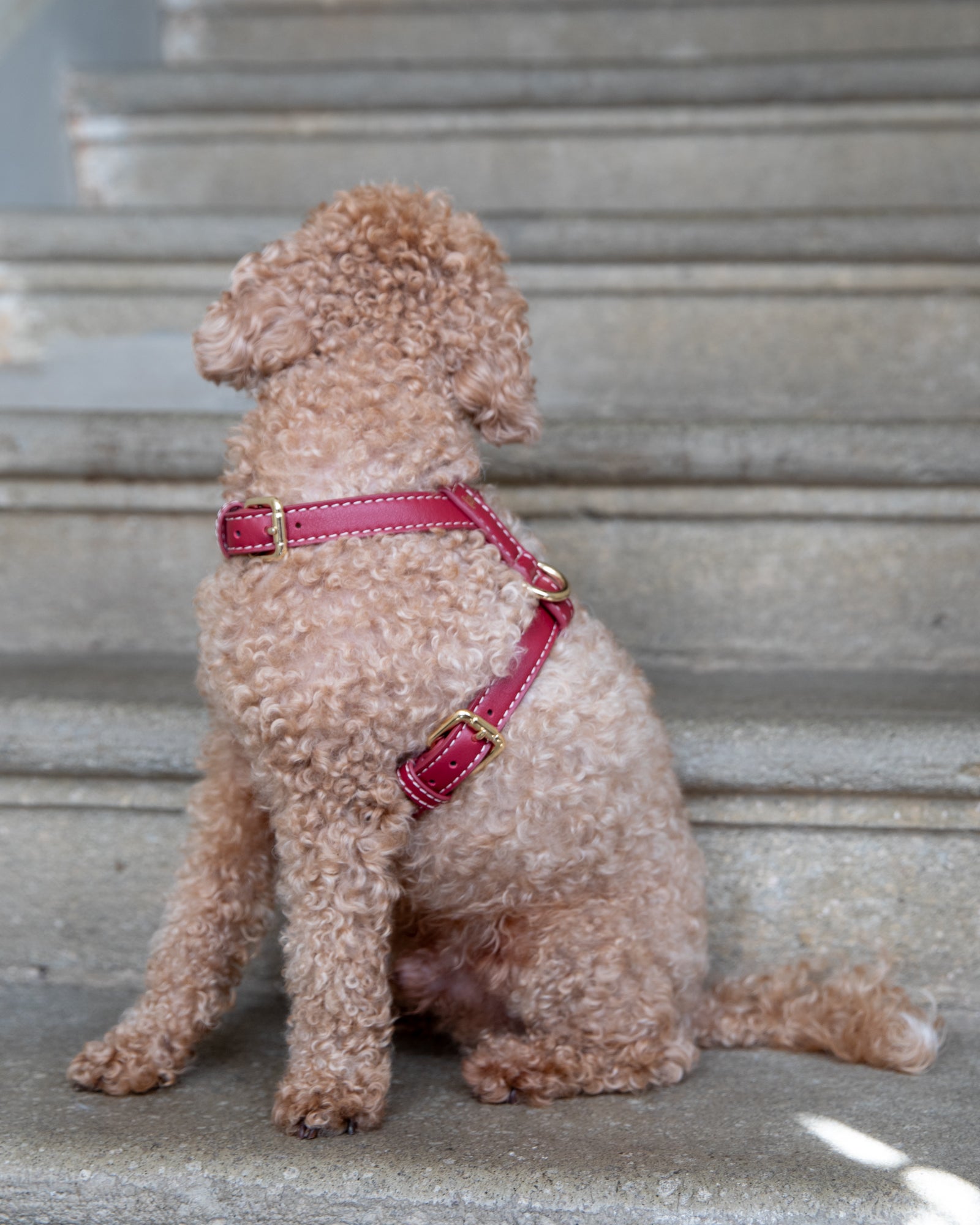
The Mario is a flat Nappa leather harness that the dog steps into rather than having placed over the head. This is a practical consideration for dogs that resist having things passed over their ears or snout — a common sensitivity in small breeds and dogs that were not habituated to harnesses as puppies.
The step-in design distributes leash force primarily across the chest. It is a good general-purpose harness for small to medium dogs without specific pulling issues. Satin gold hardware, available in several colours.
→ Mario – Step-In Leather Harness
H-shaped harness (Gabriele)
The Gabriele is an H-shaped harness in flat Nappa leather with two independent adjustable buckles — one at the chest, one at the back. The H-shape creates two separate panels: one around the chest and one across the back, connected by a central strap.
This structure distributes force across a larger surface area than a step-in, which makes the Gabriele a good option for dogs that pull with some regularity, dogs with deeper chests, and dogs where precise fit matters — the two separate buckles allow independent adjustment at chest and back. Shiny gold hardware. Designed for small to medium dogs.
→ Gabriele – H-Shaped Leather Harness
Y-shaped harness (Franco)
The Franco is a Y-shaped harness in striped webbing with leather details and shiny silver hardware. The Y-shape is defined by straps that converge at the sternum rather than crossing the chest — the result is a front panel that leaves the shoulder blades completely free.
Free shoulder movement matters for dogs with a longer stride, dogs used in active pursuits, and breeds where shoulder mechanics are part of the natural gait. For everyday walking, the difference is less significant, but the Y-shape is generally considered the design that least interferes with natural movement. Available in three adjustable sizes for medium to large dogs, up to 40 kg.
→ Franco – Y-Shaped Ribbon & Leather Harness
Can you use both?
Many owners use a collar and a harness together — the collar as a permanent ID tag holder, the harness as the leash attachment point during walks. This is practical and appropriate for most dogs. The collar in this scenario does not need to be heavy or wide, since it is not bearing leash force. A lightweight braided collar in the dog's correct size is sufficient.
Some owners switch seasonally or by context: collar for calm walks on familiar routes, harness for busier environments, longer distances, or situations where the dog is more stimulated and likely to pull.
A note on fit
Neither a collar nor a harness functions correctly if it does not fit. A collar that is too loose slips off the head; one that is too tight restricts breathing and creates constant pressure. A harness that is too loose shifts position and concentrates pressure on the wrong points; one that is too tight restricts movement and, in some designs, chafes the armpits.
The two-finger rule applies to both: you should be able to slip two fingers under any strap or band without force, but not more. For harnesses with multiple adjustment points, check fit at all points — a harness that is correctly sized at the chest may still be too tight or too loose across the back.
Fit changes. Dogs' weight fluctuates, and a piece that fitted correctly three months ago may not fit the same way now. A regular check — once a month is reasonable — catches any changes before they become a problem.
The 2.8 walking line
The full walking line includes the Ferdinando braided leather collar and matching leash (six sizes, XS to XL), the Mario flat padded collar and step-in harness, the Gabriele H-harness, and the Franco Y-harness. All are handmade in Italy, with metal hardware sized to the product rather than oversized.
The brand was founded in Venice in 2016 by Anna Bussolotto.