
The Dog Collar Guide for Small Breeds
What to look for beyond size — width, weight, fit, and why material matters more than most guides admit.
Most collar guides for small dogs focus on one thing: neck circumference. Measure the dog, add two fingers, choose the size.
For smaller breeds — dachshunds, miniature pinschers, Yorkshire terriers, Italian greyhounds, French bulldogs, toy poodles, chihuahuas — collar choice involves several other variables that affect both comfort and long-term condition. Width, weight, material, and how the collar behaves over time all matter, and they interact with each other in ways that a size chart alone does not capture.
Width: proportional, not arbitrary
Collar width determines how pressure is distributed across the neck when the leash is attached and the dog moves or pulls. A narrow collar concentrates force on a small area; a wider collar spreads it across more surface.
For large breeds, wider collars are generally recommended for this reason. For small breeds, the calculation is different. A collar that is too wide for a small dog's neck is disproportionate, adds unnecessary weight, and can restrict the natural movement of the head. The recommended width for small to miniature breeds is typically 1 to 1.5 cm — roughly 3/8 to 5/8 inch. This range provides enough surface area to distribute leash pressure without bulk.
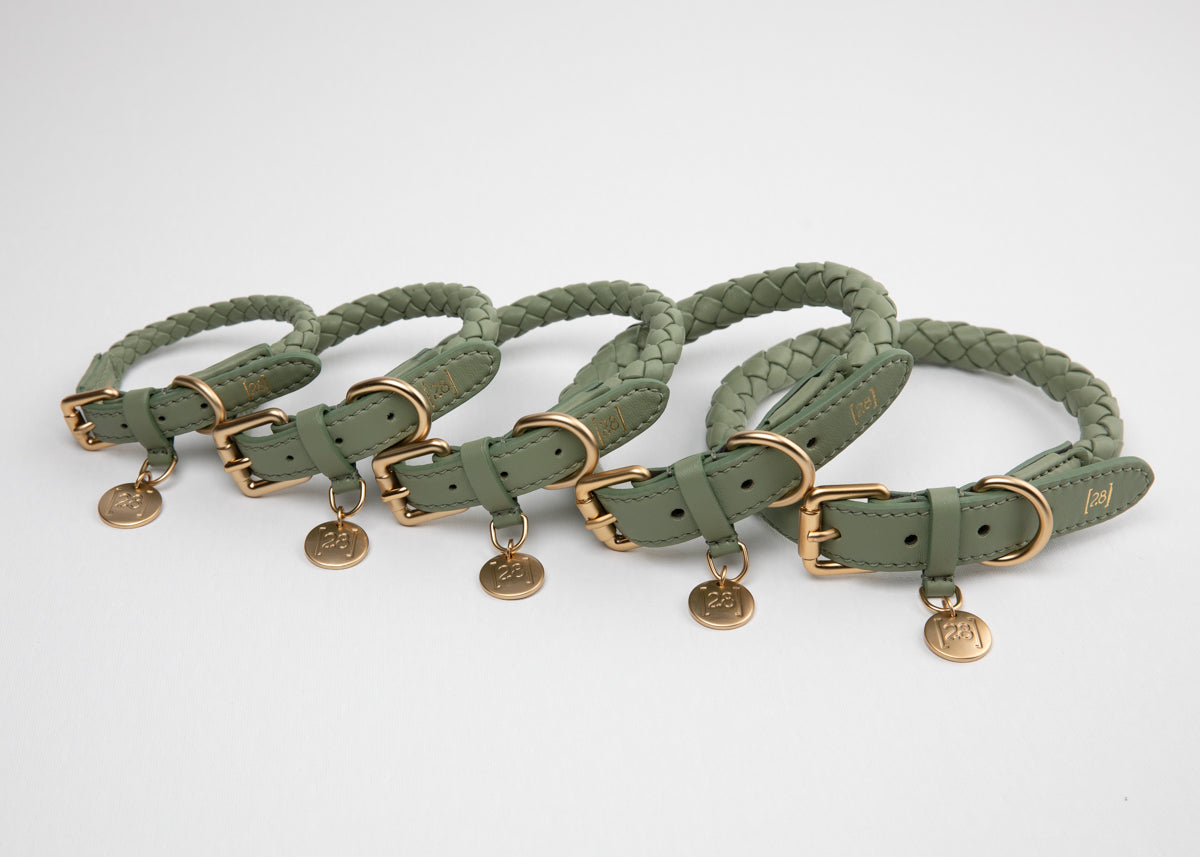
The Ferdinando braided collar by 2.8 is available in six sizes — from XXS to XL — with the braid width proportioned to each size. The narrowest version, designed for miniature and toy breeds, measures approximately 1 cm in braid width, keeping the collar light and close to the neck without digging in.
For dogs with particularly delicate or narrow necks — sighthounds such as Italian greyhounds and Whippets, or any breed where the neck tapers significantly from base to skull — the standard Ferdinando proportions may not be the right fit. The Mario greyhound collar addresses this specifically: it is internally padded, wider at the centre and narrower at the buckle ends, and designed to sit securely on a narrow neck without needing to be fastened tightly. The wider central profile distributes contact more gently across the throat, and the internal padding makes it one of the softest options against skin with very little coat coverage.
Weight: often overlooked, consistently relevant
For small breeds, collar weight matters in a way it simply does not for larger dogs. A collar that represents a negligible proportion of a Labrador's bodyweight can represent a meaningful one for a miniature dachshund or a toy poodle.
Heavy collars — those with large metal hardware, thick leather, or wide webbing — sit differently on a small dog. The weight pulls the collar forward toward the throat rather than letting it rest at the mid-neck, which over time concentrates pressure in exactly the wrong place. For all-day wear, a lighter collar is not a stylistic preference but a practical one.
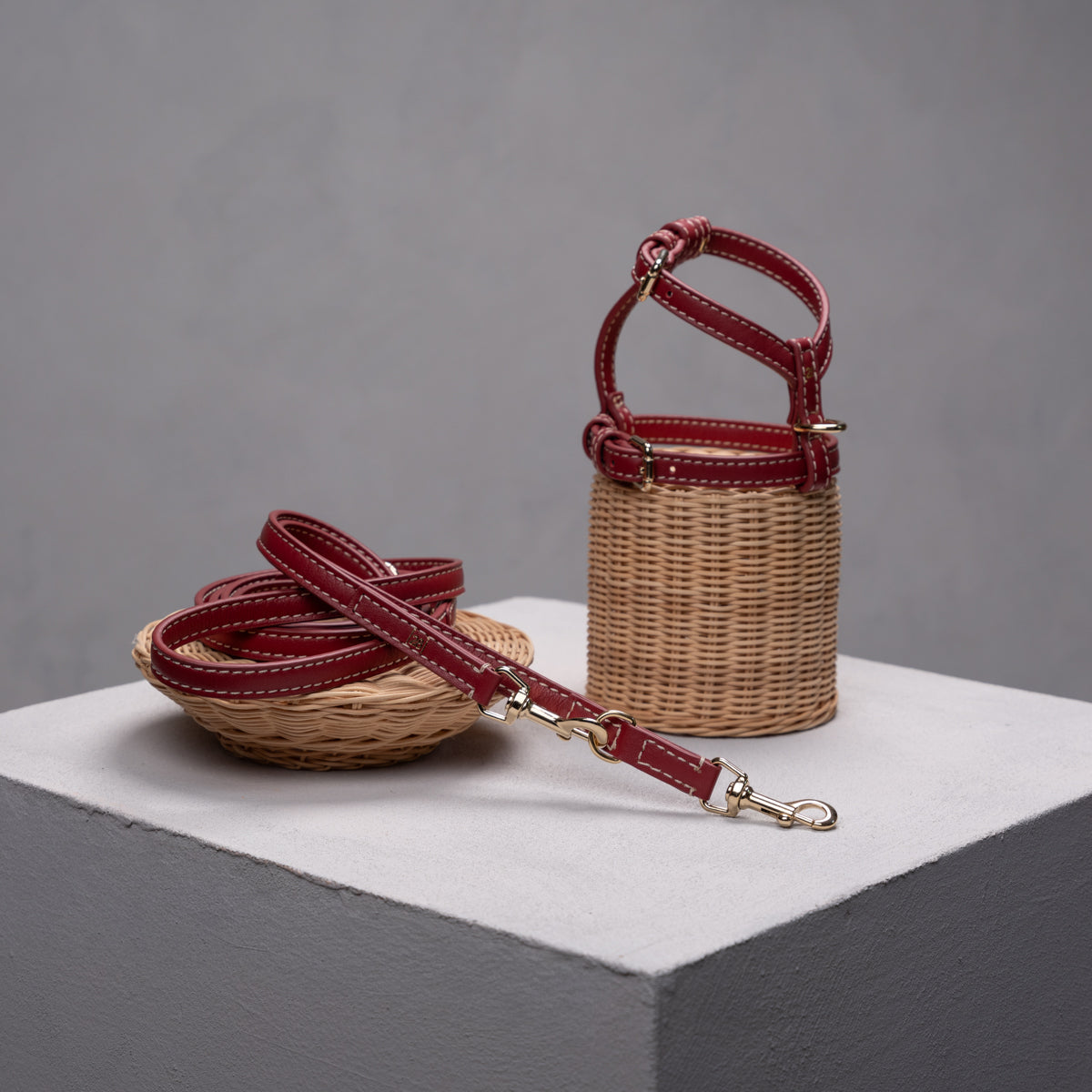
The Ferdinando's braided Nappa leather and proportioned hardware keep the collar light without compromising structure. At smaller sizes, the carabiner and D-ring are scaled down accordingly — not the same hardware as the large collar, but fittings designed for the weight and neck size of a small dog.
Material: what changes with use
The most relevant question about collar material is not how it feels on day one, but how it behaves after six months of daily wear.
Nylon remains largely unchanged over time. It does not soften and does not adapt to the dog's neck — a nylon collar feels the same on day one as it does a year later, which is to say it continues to present the same edge and texture regardless of how the dog's neck has changed.
Italian Nappa leather — the material 2.8 uses for both the Ferdinando and Mario collars — behaves differently. Nappa is a full-grain leather selected for suppleness from the start. With daily wear, it softens further and begins to conform subtly to the shape of the dog's neck. The result is a collar that fits more precisely after a month of use than it did on day one. This matters particularly for dogs with narrow, irregularly shaped, or very sensitive necks — a category that includes many small breeds and virtually all sighthounds.
Nappa leather does not fray. Nylon frays at edges and seams over time, particularly when exposed to moisture. A Nappa leather collar, kept dry and wiped clean regularly, maintains its structure for years. On the Ferdinando, the larger sizes include an internal reinforcement layer to ensure structural integrity is preserved at every size across the range.
Fit: the two-finger rule and its limits
The standard guidance — fit two fingers between the collar and the dog's neck — is a useful starting point. Applied correctly, it means the collar is snug enough not to slip over the head but loose enough not to restrict breathing or create constant pressure.
For flat collars, this works well. For a braided collar like the Ferdinando, the rounded cross-section means the contact with the neck is already gentler than a flat edge, which gives some additional tolerance. A collar fitted correctly will sit at the mid-neck and rest there without shifting.
One practical note worth keeping in mind: collar fit should be checked regularly. A dog's neck changes with weight fluctuations — puppies grow, adults fluctuate with seasons and activity levels — and a collar that fitted correctly six months ago may not fit the same way now. The Ferdinando's adjustable fit accommodates a range of neck circumferences within each size, but the adjustment should be revisited periodically rather than treated as a one-time decision.
Collar vs. harness: a practical note
For small breeds with confirmed tracheal sensitivity, respiratory conditions — as is common in brachycephalic breeds such as French bulldogs and pugs — or a history of cervical disc issues, veterinary professionals often recommend attaching the leash to a harness rather than a collar during walks. In these cases, the collar's role is to carry an ID tag, and weight becomes even more relevant: a lighter collar is better when its primary function is identification rather than leash attachment.
For dogs without these conditions, a well-fitted collar attached to a leash is appropriate for walks, provided the sizing and material choices above have been followed.
2.8 offers three harness styles suited to different body types and use cases:
The Gabriele H-shaped harness is handcrafted from flat Nappa leather with two independent adjustable buckles — one at the chest and one at the neck — allowing a precise fit regardless of the dog's specific proportions. The H-construction distributes leash pressure across the chest and shoulders with no concentrated point of contact. It runs from XS (neck 24–30 cm, chest 35–43 cm) through XL, making it suitable for small to medium breeds.
The Mario step-in harness is a lightweight Nappa leather step-in design — meaning the dog steps into it from the front rather than having anything placed over the head. This is a practical consideration for dogs that are sensitive to having things lifted over their ears. It is designed for small to medium dogs and is available in four colours.
For medium and large dogs where a harness is preferred, the Franco Y-shaped harness — made from striped cotton ribbon with natural leather detailing — is designed for dogs up to 40 kg and accommodates breeds from Cocker Spaniels through to Labradors and Dobermanns. It is not suitable for small breeds, as sizing begins at a neck circumference of 38 cm.
The 2.8 walking collection for small breeds: a quick reference
For the collar: The Ferdinando braided collar in XXS, XS, or S covers most small breeds. For sighthound anatomy — Italian greyhounds, Whippets, or any dog with a very narrow, tapering neck — the Mario greyhound collar is the more appropriate choice.
For the harness: The Gabriele suits dogs where a precise, adjustable fit matters and where the leash attaches at the back. The Mario step-in suits dogs that resist harnesses placed over the head.
For sizing: All measurements for collars and harnesses are based on neck and chest circumference rather than body weight, as weight is a poor predictor of the dimensions that actually determine fit. The 2.8 size guide includes a breed reference and a measurement calculator.
All 2.8 walking accessories are handcrafted in Italy from Italian materials. The brand was founded in Venice in 2016 by Anna Bussolotto.
Browse the full walking collection — collars, leashes, and harnesses for all breeds and sizes — at duepuntootto.com.